
A panel can be unused and still be unsuitable for general stock. It may have been cut for one opening, staged in dust or sunlight, removed from protective packaging, mixed with a different mesh or color, or separated from its approved fixing kit. Returning it under a generic cat net SKU can create the next project's shortage or mismatch.
Start with the original project and panel ID, not appearance. Confirm whether the pack was opened, compare measured panel condition and identity to the controlled record, separate standard unopened material from custom-cut pieces, reconcile accessories, and assign a saleable, project-reserve, rework-review, or reject status through the distributor's own policy.
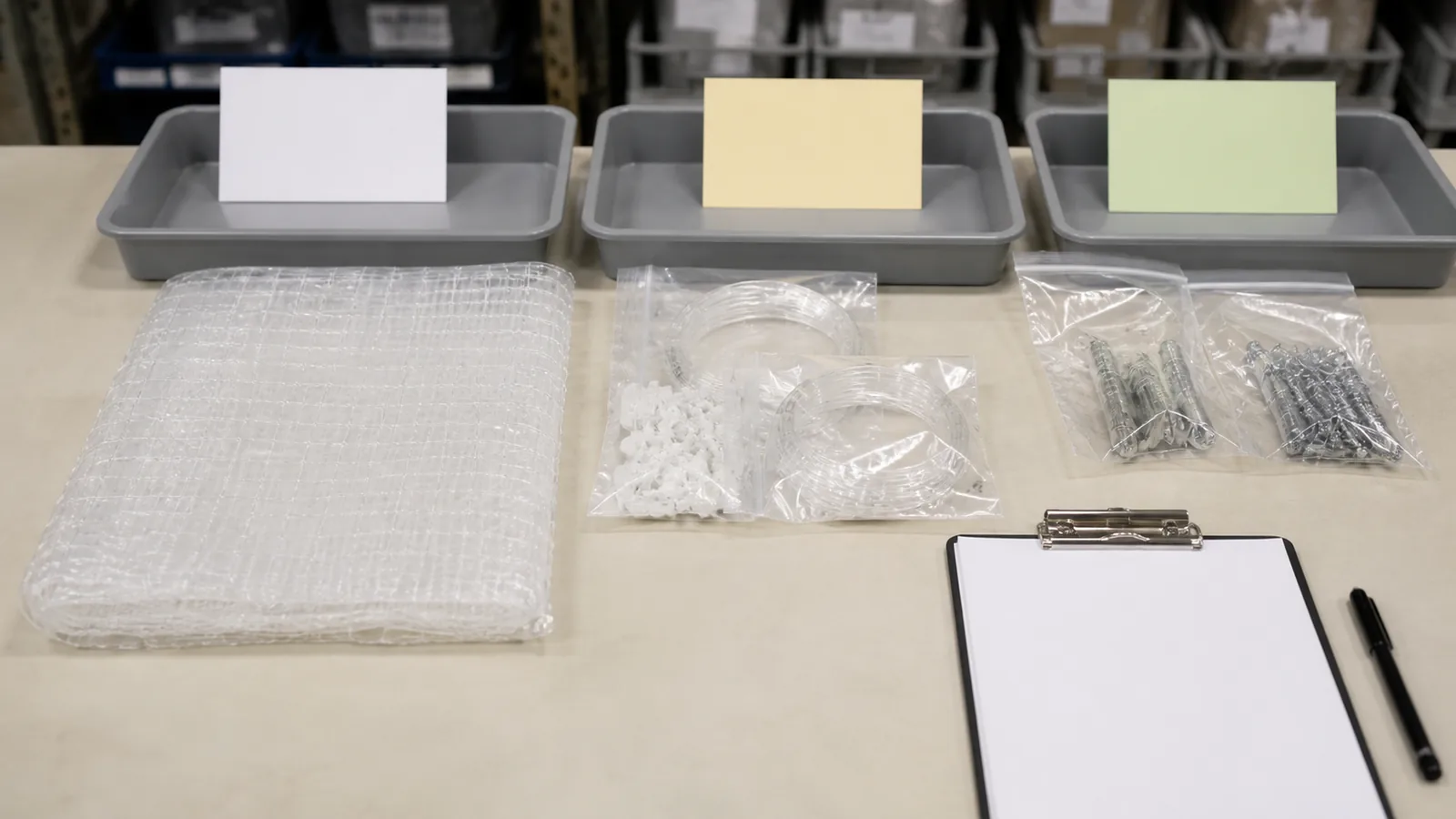
Recover the Original Project Identity
Link the return to the order, opening, and panel schedule before unpacking it. For the cat net unused panel return workflow, this checkpoint joins project order, panel ID, opening ID, and mesh specification to a named status and responsible role.
Owner's Working Record
- project order: Locate the evidence for project order, then place it in the cat net unused panel return record with responsibility and timing visible.
- panel ID: Locate the evidence for panel ID, then place it in the cat net unused panel return record with responsibility and timing visible.
- opening ID: Locate the evidence for opening ID, then place it in the cat net unused panel return record with responsibility and timing visible.
- mesh specification: Locate the evidence for mesh specification, then place it in the cat net unused panel return record with responsibility and timing visible.
- color: Locate the evidence for color, then place it in the cat net unused panel return record with responsibility and timing visible.
- cut or roll format: Locate the evidence for cut or roll format, then place it in the cat net unused panel return record with responsibility and timing visible.
Failure path: Accepting material under a generic product name when its custom dimensions and project history are unknown. Test the cat net unused panel return sequence through project order, panel ID, and opening ID. A mismatch should remain attached to mesh specification, not disappear inside a general comment.
Closeout point: The return has a traceable source and controlled product description. Close this cat net unused panel return stage only when color, cut or roll format, and original packing list support the same status.
Separate Unopened, Opened, and Cut Material
Create distinct return groups before pieces are combined on a worktable. For the cat net unused panel return workflow, this checkpoint joins seal condition, opened date when known, custom cut, and edge finish to a named status and responsible role.
Decision Fields
- seal condition: Treat seal condition as a decision field for cat net unused panel return; preserve the observed value, its source, reviewer, and unresolved status.
- opened date when known: Treat opened date when known as a decision field for cat net unused panel return; preserve the observed value, its source, reviewer, and unresolved status.
- custom cut: Treat custom cut as a decision field for cat net unused panel return; preserve the observed value, its source, reviewer, and unresolved status.
- edge finish: Treat edge finish as a decision field for cat net unused panel return; preserve the observed value, its source, reviewer, and unresolved status.
- folding method: Treat folding method as a decision field for cat net unused panel return; preserve the observed value, its source, reviewer, and unresolved status.
- protective packaging: Treat protective packaging as a decision field for cat net unused panel return; preserve the observed value, its source, reviewer, and unresolved status.
Reason for control: Mixing a factory pack with field-cut remnants because both appear clean. The cat net unused panel return reviewer uses seal condition to identify the item, opened date when known to confirm context, and custom cut to show responsibility. Any conflict stays linked to edge finish.
Decision gate: Each group has a clear packaging and modification history. The cat net unused panel return decision cites folding method, records protective packaging, and leaves group identifier open if follow-up remains.
Inspect Mesh and Edge Condition
Check visible strands, seams, edge finish, tangles, contamination, and storage effects. For the cat net unused panel return workflow, this checkpoint joins mesh identity, strand observation, seam, and edge finish to a named status and responsible role.
Handover Evidence
- mesh identity: The cat net unused panel return handoff names mesh identity, where it was checked, who checked it, and what must happen next.
- strand observation: The cat net unused panel return handoff names strand observation, where it was checked, who checked it, and what must happen next.
- seam: The cat net unused panel return handoff names seam, where it was checked, who checked it, and what must happen next.
- edge finish: The cat net unused panel return handoff names edge finish, where it was checked, who checked it, and what must happen next.
- tangle or distortion: The cat net unused panel return handoff names tangle or distortion, where it was checked, who checked it, and what must happen next.
- surface contamination: The cat net unused panel return handoff names surface contamination, where it was checked, who checked it, and what must happen next.
Review trigger: Straightening or cleaning a panel before the original return condition is recorded. When that trigger appears, the cat net unused panel return owner checks mesh identity against strand observation, preserves seam, and routes edge finish to the proper authority.
Handover test: Inspection evidence supports the assigned condition without a hidden intervention. The next cat net unused panel return role receives tangle or distortion, surface contamination, and the current state of photographs rather than a verbal assurance.
Measure Custom Panels Without Guessing
Record the relaxed panel geometry and compare it with the original schedule. For the cat net unused panel return workflow, this checkpoint joins panel length, panel height, shape, and corner or step to a named status and responsible role.
Traceable Records
- panel length: Link panel length to the physical cat net unused panel return item; note evidence, custody, date, exception state, and authorized follow-up.
- panel height: Link panel height to the physical cat net unused panel return item; note evidence, custody, date, exception state, and authorized follow-up.
- shape: Link shape to the physical cat net unused panel return item; note evidence, custody, date, exception state, and authorized follow-up.
- corner or step: Link corner or step to the physical cat net unused panel return item; note evidence, custody, date, exception state, and authorized follow-up.
- seam position: Link seam position to the physical cat net unused panel return item; note evidence, custody, date, exception state, and authorized follow-up.
- measurement method: Link measurement method to the physical cat net unused panel return item; note evidence, custody, date, exception state, and authorized follow-up.
Control risk: Forcing flexible mesh to a target number and recording it as a standard stock size. Use panel length and panel height to reconstruct this cat net unused panel return event. If shape conflicts with corner or step, protect the affected item and name the reviewer.
Authorized release: The measured panel is identified as project-specific or demonstrably matches a controlled stock format. Record the cat net unused panel return outcome beside seam position, measurement method, and variance note; unresolved evidence keeps the stage open.
Reconcile Every Accessory Pack
Count and identify hardware, cable, ties, clips, or other supplied items by the actual kit. For the cat net unused panel return workflow, this checkpoint joins kit ID, sealed pouch, item description, and quantity unit to a named status and responsible role.
Evidence to Capture
- kit ID: For cat net unused panel return, capture kit ID at its source; connect kit ID to an owner, current status, location, and date.
- sealed pouch: For cat net unused panel return, capture sealed pouch at its source; connect sealed pouch to an owner, current status, location, and date.
- item description: For cat net unused panel return, capture item description at its source; connect item description to an owner, current status, location, and date.
- quantity unit: For cat net unused panel return, capture quantity unit at its source; connect quantity unit to an owner, current status, location, and date.
- missing item: For cat net unused panel return, capture missing item at its source; connect missing item to an owner, current status, location, and date.
- mixed finish: For cat net unused panel return, capture mixed finish at its source; connect mixed finish to an owner, current status, location, and date.
Exception analysis: Combining loose hardware from different projects without compatibility or finish control. In the cat net unused panel return file, compare kit ID with sealed pouch; use item description and quantity unit to locate the break. Keep missing item visible while the assigned role investigates.
Release evidence: All accessories have identity, quantity, condition, and a project or stock status. For cat net unused panel return, connect that result to mixed finish and condition, including any open owner and next review date.
Assign and Label the Inventory Disposition
Route material to standard stock, project reserve, review, or rejection under the distributor's policy. For the cat net unused panel return workflow, this checkpoint joins disposition, approver, warehouse location, and new stock code when allowed to a named status and responsible role.
Owner's Working Record
- disposition: Locate the evidence for disposition, then place it in the cat net unused panel return record with responsibility and timing visible.
- approver: Locate the evidence for approver, then place it in the cat net unused panel return record with responsibility and timing visible.
- warehouse location: Locate the evidence for warehouse location, then place it in the cat net unused panel return record with responsibility and timing visible.
- new stock code when allowed: Locate the evidence for new stock code when allowed, then place it in the cat net unused panel return record with responsibility and timing visible.
- project reserve: Locate the evidence for project reserve, then place it in the cat net unused panel return record with responsibility and timing visible.
- review action: Locate the evidence for review action, then place it in the cat net unused panel return record with responsibility and timing visible.
Failure path: Putting inspected returns back into saleable stock before authorization and traceable relabeling. Test the cat net unused panel return sequence through disposition, approver, and warehouse location. A mismatch should remain attached to new stock code when allowed, not disappear inside a general comment.
Closeout point: The system and physical location reflect the same approved status. Close this cat net unused panel return stage only when project reserve, review action, and closure balance support the same status.
Returning Unused Cat Net Panels and Accessories to Distributor Stock Control Matrix
This cat net unused panel return matrix keeps each checkpoint beside its own evidence and release question. Use a separate row whenever the physical item, location, responsible role, or decision status changes.
| Cat Net Unused Panel Return checkpoint | Evidence for this decision | Question before movement |
|---|---|---|
| Recover the Original Project Identity | project order, panel ID, opening ID, and mesh specification | the return has a traceable source and controlled product description. |
| Separate Unopened, Opened, and Cut Material | seal condition, opened date when known, custom cut, and edge finish | each group has a clear packaging and modification history. |
| Inspect Mesh and Edge Condition | mesh identity, strand observation, seam, and edge finish | inspection evidence supports the assigned condition without a hidden intervention. |
| Measure Custom Panels Without Guessing | panel length, panel height, shape, and corner or step | the measured panel is identified as project-specific or demonstrably matches a controlled stock format. |
| Reconcile Every Accessory Pack | kit ID, sealed pouch, item description, and quantity unit | all accessories have identity, quantity, condition, and a project or stock status. |
| Assign and Label the Inventory Disposition | disposition, approver, warehouse location, and new stock code when allowed | the system and physical location reflect the same approved status. |
Returning Unused Cat Net Panels and Accessories to Distributor Stock Release Checklist
- Retain project order while the cat net unused panel return owner closes recover the original project identity.
- Retain seal condition while the cat net unused panel return owner closes separate unopened, opened, and cut material.
- Retain mesh identity while the cat net unused panel return owner closes inspect mesh and edge condition.
- Retain panel length while the cat net unused panel return owner closes measure custom panels without guessing.
- Retain kit ID while the cat net unused panel return owner closes reconcile every accessory pack.
- Retain disposition while the cat net unused panel return owner closes assign and label the inventory disposition.
Questions About Returning Unused Cat Net Panels and Accessories to Distributor Stock
Why separate cat net unused panel return from a general checklist?
A dedicated record keeps original project ID beside opened-pack status, while mesh and color identity and cut dimensions remain attributable to their owners. A broad checklist usually loses that sequence.
What evidence should exist at the opening gate?
Use project order; panel ID; opening ID; mesh specification; color; cut or roll format; original packing list as the opening evidence set for cat net unused panel return. Resolve missing revisions or unclear ownership before the operation moves forward.
How is an exception contained?
Treat this condition as the stop trigger: forcing flexible mesh to a target number and recording it as a standard stock size. The cat net unused panel return owner records the location, protects the item from normal use, and routes the question to the authorized role.
Are fixed limits supplied here?
They are not. No returned item is declared saleable, reusable, or safe without inspection and the distributor's applicable policy. The controlled order, selected model, approved drawing or survey, and assigned reviewer govern the actual cat net unused panel return release.
Related Product or Reading
- Transparent nylon cat net range: keeps the recommendation tied to the verified product scope and exact equipment or material identity
- Staging Cat Net Panels in Occupied Buildings Before Installation: covers the nearest adjacent buyer task without duplicating the workflow in this article
Prepare the Review File
Send original project ID, opened-pack status, mesh and color identity, cut dimensions, accessory reconciliation, condition inspection, inventory disposition to MaxCatNet. For this cat net unused panel return request, those records let the team review the selected transparent nylon cat net project against the buyer task and verified product scope.