A cat net is mesh used as part of a boundary around a balcony or window. It needs to fit the opening, the way the space is used and the fixing arrangement. Choosing between transparent nylon and wire-reinforced netting is one part of that decision. The panel edges, upper boundary and any moving window sections need attention too.
This guide helps owners, installers and trade buyers prepare a useful project brief. Start with the space, compare the two product families, then use the linked measurement and installation guides for the details. The aim is to identify what the project needs before ordering a net or a kit.
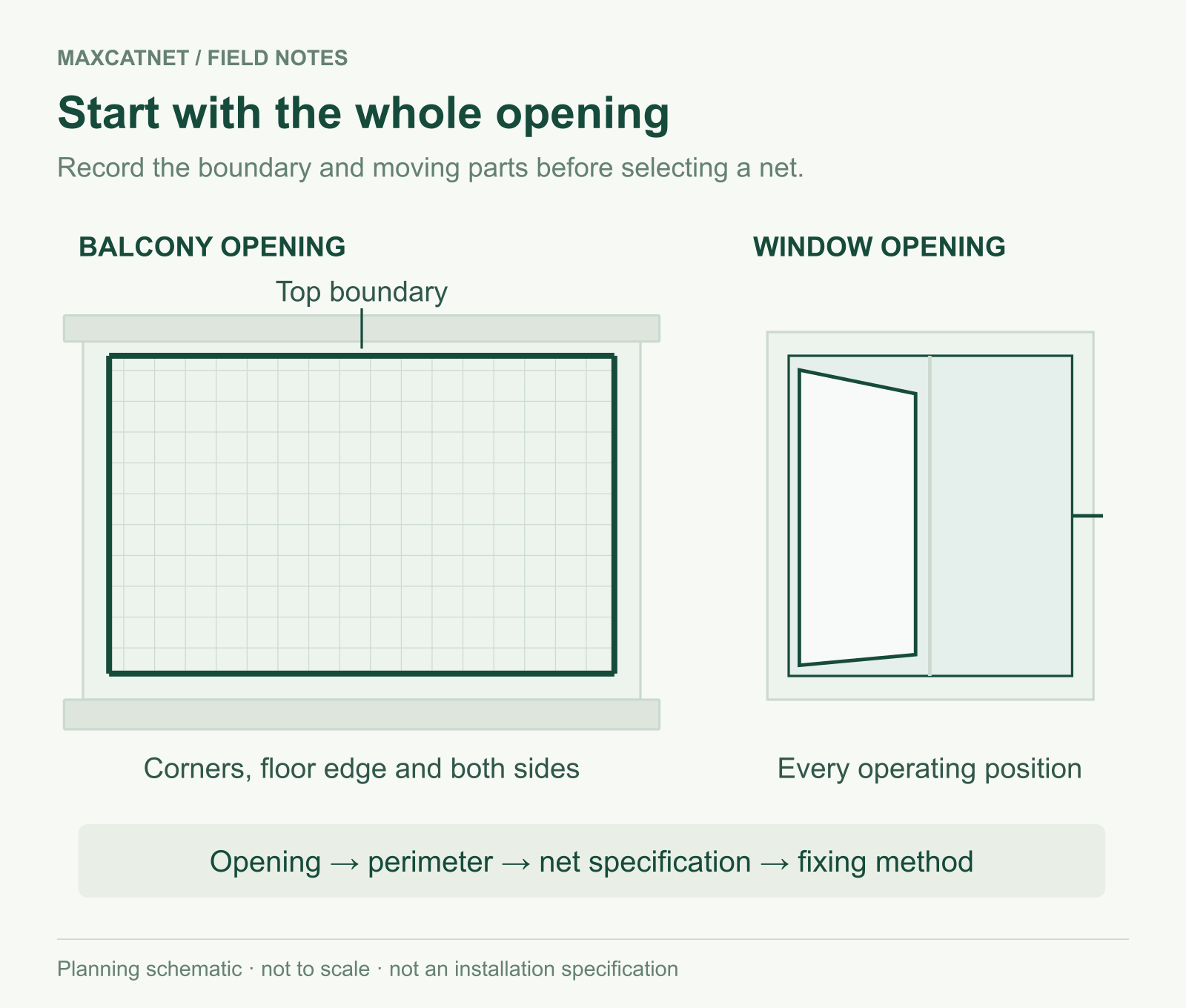
Start with the balcony or window opening
For a balcony, record the whole opening rather than only the railing dimensions. Include the floor edge, both sides, corners and any space above the proposed panel. Note whether there is a ceiling or an open top, and photograph beams, pipes and ledges that interrupt the boundary.
Cats Protection recommends ceiling-to-floor balcony coverage and supervision. It also highlights the risks of entanglement and gaps in poorly secured netting. Keep the cat away during assessment and installation, and restrict access if the proposed enclosure has unresolved openings.
At a window, note the frame type and every position used for ventilation, opening or cleaning. Show the installer where the sash, handle and hinges move. A panel that fits when the window is shut may leave a different opening when it moves.
Tilt-and-turn windows need a separate check. Cats Protection warns about cats becoming trapped in the V-shaped gap of a tilted window. An exterior net does not necessarily prevent access to that gap. Use the tilt-and-turn window planning guide to record the operating modes and the proposed protection.
Compare the two cat net product families
MaxCatNet’s documented range includes transparent nylon monofilament netting and HDPE mesh with wire reinforcement. Compare the proposed sample and specification for your project rather than assigning a material to a cat’s weight or activity level alone.
| Product family | What to consider | What to confirm for the order |
|---|---|---|
| Transparent nylon monofilament net | Appearance against the view, light and surrounding surfaces; the proposed panel and perimeter arrangement. | Filament and mesh specification, finished size, edge treatment and the accessories supplied. |
| HDPE mesh with wire reinforcement | The specified reinforced construction, colour and how the sample fits the intended opening and fixing system. | Polymer and wire construction, finished strand specification, mesh, edges and any relevant performance evidence. |
Transparent netting remains a visible physical material; its appearance changes with lighting, background and viewing distance. Review a sample in the intended setting if appearance is important to the project.
Wire reinforcement is a construction detail, not a promise that a cat cannot chew, climb or escape. Describe any observed chewing or climbing in the enquiry. The chewing guide and climbing guide help separate damaged mesh from an accessible route around the net.
Choose mesh and panel dimensions separately
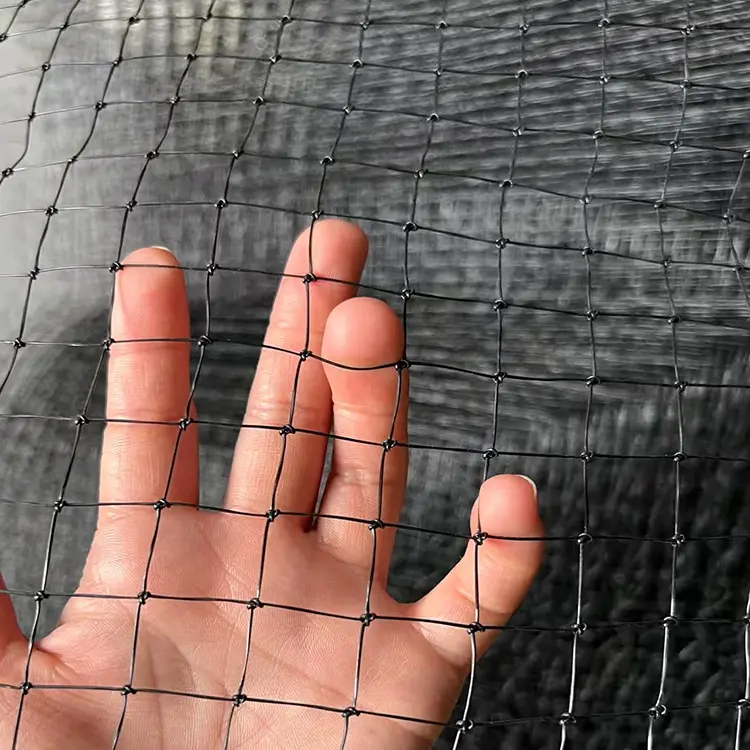
Mesh size describes the repeated openings within the net. Panel size describes the width and length of the piece being supplied. Both belong in a quotation, but neither tells the whole story of an installed boundary.
Ask how the mesh is measured: a clear opening and a centre-to-centre measurement are different descriptions. Agree the measurement condition and identify which diameter is quoted for a reinforced strand. The mesh and strand specification guide explains those terms.
Do not select a mesh from a universal kitten-versus-adult rule. Consider the individual animal, the mesh in use, the gaps at the perimeter and the intended installation. A smaller nominal opening does not close a gap beside a wall or above a railing.
For the panel, measure the actual opening and proposed fixing line. Mark irregular areas and keep width and height labels consistent between the sketch and the order. Confirm cutting, edge treatment and any installation allowance with the supplier or installer; do not add an arbitrary percentage to every project. Follow the balcony measurement steps before deciding the required supply size.
Select a fixing method for the actual surface
Drilled and no-drill methods need the right components and suitable supporting surfaces. Record the wall or frame material, its condition, exposure and any building restrictions. For rented property, check permission before deciding how the net will be attached.
If adhesive hooks are proposed, ask for the exact hook and adhesive, supported substrates, preparation and curing instructions. “No drill” does not mean every surface is suitable or that removal will always leave no mark. A kit photograph cannot establish the adhesive’s compatibility with your frame or wall.
For drilled fixings, the installer needs to choose an appropriate anchor and location for the actual structure. Do not copy a fixing spacing or tension value from an unrelated kit. Compare the options in the no-drill versus drilled installation guide, then prepare a component list for the selected arrangement.
Ask whether the quotation covers netting alone or a kit. If it is a kit, agree each component and quantity, the net finish and the instructions supplied. This helps the buyer identify missing items before the installation starts.
Check the finished boundary and keep a record
With the cat kept away, inspect the completed perimeter and demonstrate the intended window positions. Look for loose or damaged strands, connections pulling away, accessible corner or sill gaps, and contact between moving parts and the net. Resolve issues before allowing access; do not use a live cat to test the installation.
Continue to supervise balcony use. Keep the product identification, installation instructions, component list and photographs of the finished arrangement. Record what should prompt another inspection, such as visible damage, a moving fixing, a changed window position or furniture that creates a new route towards an edge.
Use the maintenance and inspection guide to organise later observations. Inspection intervals, cleaning compatibility and replacement decisions should follow the relevant product and system instructions and the condition found, rather than a universal service-life promise.
Trade buyers can add the intended application, pack contents and required instructions to the enquiry. The manufacturer selection checklist covers sample approval, quotation comparisons and bulk-order checks without repeating the site measurement process.
Common balcony and window cat net questions
Which is better: transparent nylon or wire-reinforced netting?
Compare the actual specification, appearance, intended use and supporting evidence. A material label alone does not establish suitability for a particular cat, opening or fixing arrangement. Request a sample where those details affect the purchase.
Can I protect a balcony without drilling?
A no-drill arrangement may be considered where permission, substrates and the component instructions support it. Confirm those conditions before ordering; an adhesive kit is not a universal solution for all balconies.
Is a panel across the front railing enough?
It may leave routes at the sides, top or corners. Record the complete opening and ask how each boundary will be addressed, especially when there is no ceiling above the balcony.
Can these cat nets be used for child fall protection?
Do not use or market these cat-net product families as child fall-protection systems. Keep that separate application out of a pet-net specification and installation claim.
Prepare a cat net enquiry
Send MaxCatNet your balcony or window brief with photographs, an opening sketch, dimensions, preferred net family and quantity. Include the fixing surfaces, operating window positions, accessory needs and destination country. For retail or branded orders, add the proposed packaging and instruction languages so the quotation can identify the intended supply clearly.