
Yes, cats can attempt to climb cat netting. Wire reinforcement should not be treated as an anti-climb feature, and a net that remains intact can still leave an escape route around its edges or above it.
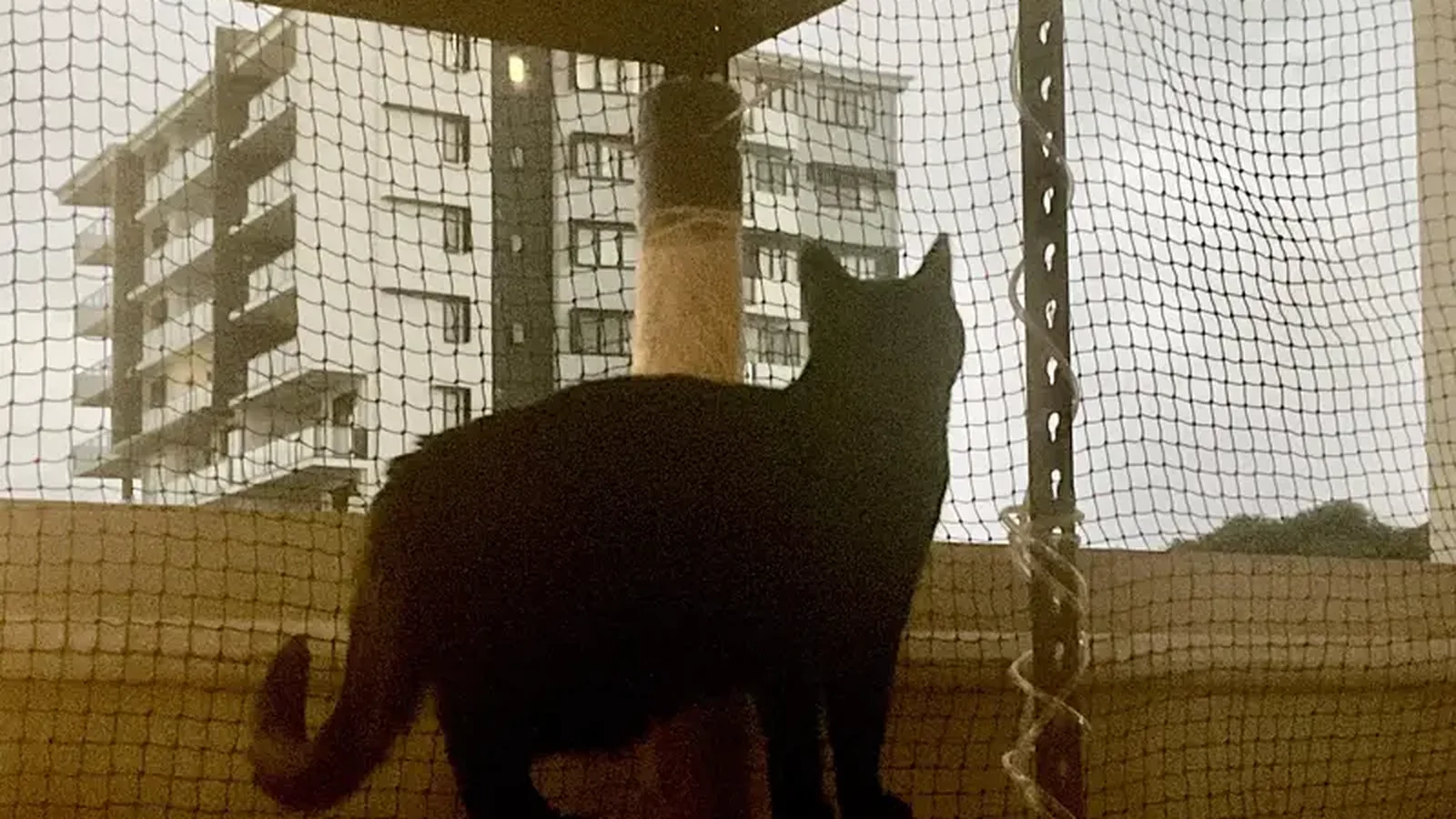
For a balcony or open window, the useful question is what the cat can reach after climbing. Check the net, its attachments and the complete opening together. FOUR PAWS’ balcony guidance specifically asks owners to consider climbing behaviour when choosing a net and to close gaps around the balcony.
This guide concerns flexible cat nets used for balcony fall prevention and window protection. If a cat is repeatedly testing an edge, trying to escape, or has changed the condition of the net, restrict access while the installation is assessed. Do not encourage climbing to test whether the barrier holds.
Climbing, chewing and escaping are different problems
A report that a cat “got through the net” can describe several different events. Identify what happened before choosing replacement material or changing the installation.
| What was observed? | What needs checking? | What a material change alone cannot answer |
|---|---|---|
| The cat climbed the mesh, which appears intact. | Where it climbed, how the panel and attachments moved, and whether it reached a top or side edge. | Whether the complete opening prevents access to the outside. |
| The cat reached above the net or around a corner. | The upper boundary, side returns, nearby ledges and the route from furniture or a windowsill. | How the unprotected route will be closed. |
| Strands were bitten, cut or pulled out of shape. | The damaged area, neighbouring mesh, edge connections and the proposed replacement specification. | Whether damage also affected the fixings or created another gap. |
Keep the material-damage discussion separate. Our guide to cats biting through safety netting covers chewing concerns and the questions to ask about nylon and wire-reinforced products.
On a balcony, follow the route to the top
Start with the whole opening, including the floor edge, corners and space above the railing. A panel across the front does not explain what happens when a cat reaches its upper edge.
For a balcony with a ceiling, inspect how the planned barrier meets that ceiling and both side boundaries. Look for interruptions around beams, pipes and adjoining structures. Review the furniture layout too: a chair or shelf may give the cat a different starting point from the one considered during installation.
For a balcony without a ceiling, ask how the design closes or controls the upper route. A taller piece of netting is not, by itself, a complete design. The open-top balcony planning guide explains the structural information needed before discussing supports and fixing options.
Cats Protection recommends ceiling-to-floor balcony coverage and supervision, and advises restricting access when a cat appears frustrated or eager to escape. Supervision is part of use; it does not close a gap in the barrier.
At a window, check every opening position
A window changes shape as its sash moves. A net that looks continuous with the window shut may leave access beside a hinge, under a moving section or around an edge when the window opens.
With the cat kept away from the opening, have the installer demonstrate the ventilation and cleaning positions that the owner intends to use. Record whether the net remains attached to its intended fixing line, whether the sash or handle contacts it, and whether any side or upper opening becomes accessible.
Tilt-and-turn windows need particular attention. Cats Protection warns that cats can become trapped in the V-shaped gap of a tilted window. A net positioned farther outside does not necessarily prevent access to that gap. The proposed protection must address the actual window geometry and operating modes, not only the exterior opening.
Do not assume an existing insect screen, removable frame or opening restrictor has been assessed for cat containment. Record those components so the installer can distinguish their functions from the proposed cat-net boundary.
Do not use tension as a universal anti-climb fix
Advice to “make it tighter” or “leave it loose” needs the context of a particular product and installation. For example, TRIXIE’s instructions for models 44301/44311/44321/44331/44341 specify slight sag for those nets. That instruction does not establish a suitable tension for a different net, frame or fixing system.
For an existing installation, describe the change: a local pocket, an edge pulling away, movement at a hook, or a panel that now touches the window. Compare it with the installation instructions and handover record before adjusting anything. The tension and sag inspection guide provides a way to record those observations without inventing a universal tension value.
What does this mean for nylon and wire-reinforced nets?
MaxCatNet’s documented options include transparent nylon monofilament net and HDPE mesh with wire reinforcement. These identify material constructions; they do not establish that a cat cannot climb them.
Include observed climbing and chewing in the product enquiry. Ask for the exact mesh and strand specification, relevant performance evidence, and the accessories included in the proposed supply. Net selection and installation design need to be considered together. Reinforcement cannot close an open top, secure an unsuitable anchor or resolve a gap beside a moving window.
A useful enquiry record for buyers and installers
For a distributor handling a customer question, or an installer preparing a net order, collect:
- The opening: balcony or window, dimensions, ceiling or open top, and the intended protected area.
- The observed behaviour: climbing on the mesh, reaching an edge, chewing, or pushing at a particular point. Describe an observation; do not stage a live-cat test.
- The route: where the cat started, the direction it moved and which top, corner, sill or ledge it reached.
- The condition: whole-opening photographs plus close-ups of changed mesh, attachments and gaps, taken from a safe position.
- The current system: net identity, fixing method, installation instructions and any later changes to furniture or window operation.
- The supply request: replacement panels or new netting, sizes, quantity, accessory requirements and destination country.
This gives the supplier a product brief and the installer a site question. It is more useful than asking whether a stronger net will solve an unidentified problem.
Common questions
How high does balcony cat netting need to be?
Height alone is not a reliable selection rule. The design must address the complete opening and what a cat can reach at the top. A balcony with a ceiling and an open-top balcony need different site assessments; do not transfer a garden-fence height to either without a suitable design.
Does wire-reinforced cat netting stop climbing?
Do not treat reinforcement as an anti-climb guarantee. Confirm the exact construction and assess the full opening, including the upper boundary, edges and attachments.
Should a climbing cat automatically get a smaller mesh?
No. Mesh selection, animal size, climbing behaviour and the finished perimeter gaps all need consideration. A smaller nominal opening alone does not demonstrate that the cat cannot climb or escape around the panel.
Prepare a balcony or window net enquiry
For a net or sample enquiry, send MaxCatNet the opening record and required supply details. Specify whether the project concerns a balcony or window and include the climbing observations. The quotation can then identify the proposed net and accessories, while installation suitability is assessed against the actual site.