
Cat net installation is not only a question of mesh size. The fixing method decides whether the net sits flat, covers the edges and stays practical for daily use. For balconies and windows, buyers usually compare two installation directions: no-drill fixing and drilled fixing.
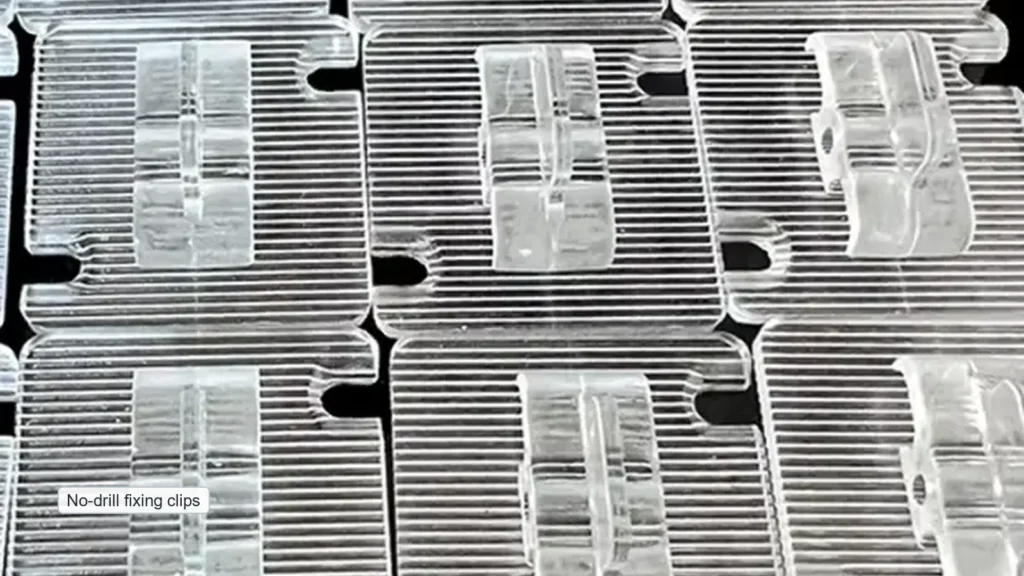
No-drill installation can be useful for rental apartments, temporary setups or surfaces where drilling is not allowed. Drilled fixing can be more direct for permanent installations when the wall, frame or ceiling allows it. Neither method should be promoted as universally suitable. The correct choice depends on the building, the cat, the mesh and the installer’s ability to tension the perimeter.
MaxCatNet’s product scope includes Transparent Nylon Cat Protection Net and Stainless Steel Wire-Reinforced Cat Net. Both need a clear fixing plan before ordering.
What No-Drill Cat Net Installation Means
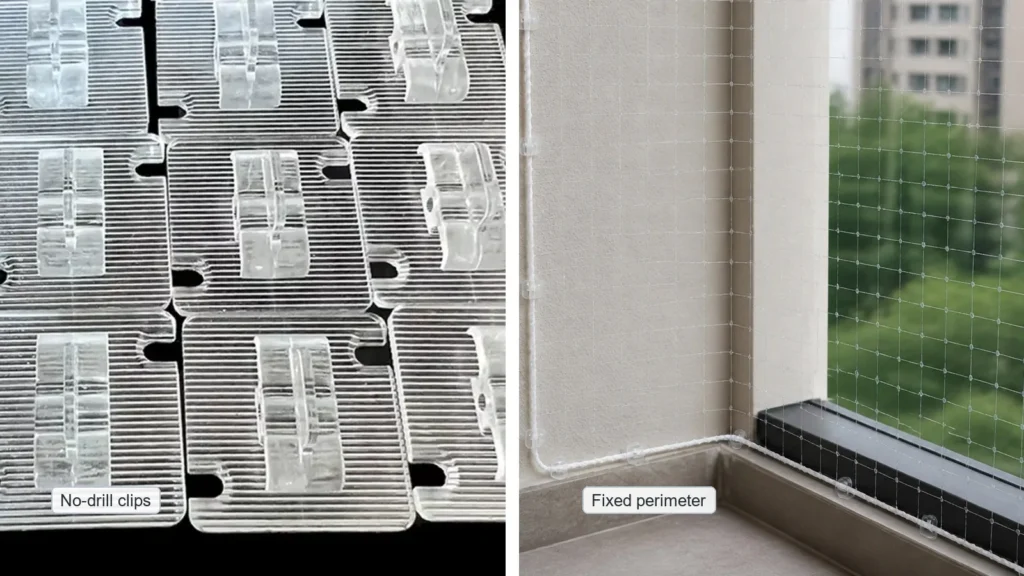
No-drill installation means the net is fixed without drilling holes into the wall, ceiling, frame or railing. Depending on the opening, it may use clips, ties, tension rope, existing rails or removable fixing points. It is often requested where the customer cannot change the building surface.
The advantage is clear: it can reduce damage to the building and may be easier to remove later. The limitation is also clear: it depends heavily on the available surfaces. Smooth tile, painted metal, rough concrete, narrow window frames and glass railings all behave differently.
Before recommending no-drill installation, confirm:
- Whether drilling is prohibited or simply not preferred
- The material of the fixing surface
- The opening size and shape
- Whether the net can be tensioned on all four sides
- Whether doors or windows still need to open
- Whether the cat climbs, chews or pushes the mesh
No-drill fixing should not be described as a shortcut that works everywhere. It is a method that must be matched to the opening.
What Drilled Installation Means
Drilled installation uses fixed anchors, hooks, screws or brackets installed into suitable surfaces. It may be preferred for larger openings, long-term use or places where stronger perimeter control is needed. A drilled installation can create a more continuous fixing line, but only if the surface is appropriate and the work is done correctly.
Drilling also introduces responsibilities. The installer must avoid pipes, cables, waterproofing layers and weak surfaces. Building rules, landlord approval and local safety requirements should be checked before drilling.
| Method | Suitable When | Watch Points |
|---|---|---|
| No-drill fixing | Drilling is restricted and the opening has usable fixing surfaces | Surface suitability, tension and edge gaps |
| Drilled fixing | Permanent fixing is allowed and the wall or frame is suitable | Building approval, anchor choice and installation quality |
| Mixed fixing | Some edges can be drilled and others need removable fixing | Consistent tension across all sides |
| Frame-based fixing | A separate frame can hold the net | Frame strength, fit and removal method |
When a Mixed Fixing Plan Is More Realistic
Many balcony and window openings are not perfect rectangles with the same surface on all four sides. One side may be concrete, another side may be aluminum, and the bottom edge may meet a glass railing or sliding door track. In these cases, a mixed fixing plan may be more realistic than forcing the entire installation into one method.
For example, a balcony may allow drilled hooks on the side walls but require removable ties along a railing. A window may use fixed points on the top and sides but need a careful no-drill solution near the opening sash. The goal is not to make the installation method sound simple. The goal is to make the perimeter continuous and practical.
When using mixed fixing, the installer should check whether tension is balanced. If one side is much stronger than another, the weaker side can become the place where a gap appears. This is why photos and edge-by-edge notes are more useful than a single width and height measurement.
Edge Tension Matters More Than the Method Name
Many installation failures happen at the edges. A net can be made from the right material and still leave a gap if the perimeter is loose. Corners, bottom edges, railing intersections and window handles need particular attention.
The installer should create a continuous fixing line. The net should not be attached only at a few distant points. If the spacing is too wide, the mesh may bow outward or create a gap when pushed.
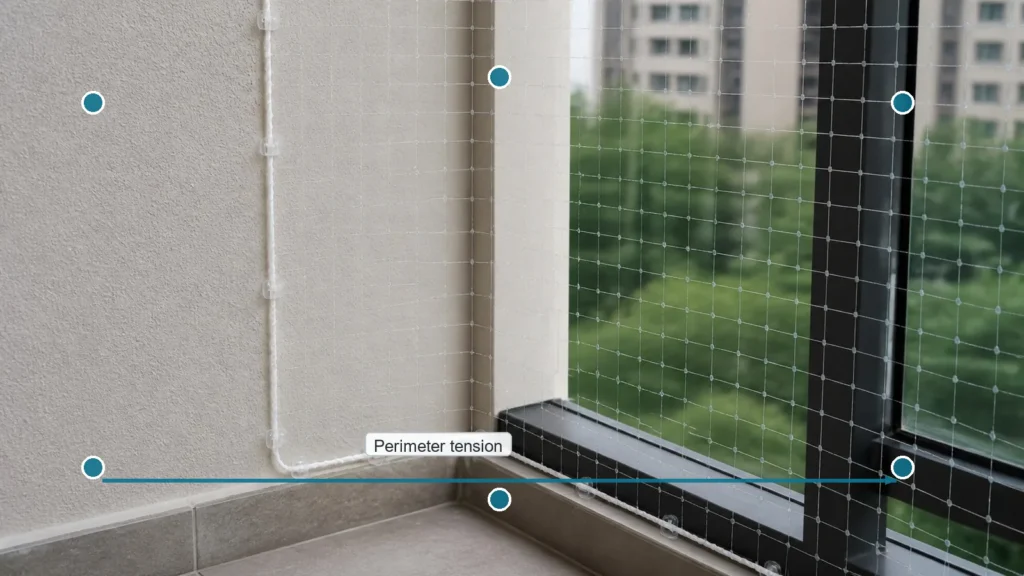
For windows, check the corners and the side where the window opens. For balconies, check the bottom edge, side walls and any railing gaps. If the balcony has glass panels, the fixing method may be very different from a concrete wall or metal railing.
Mesh Choice Still Matters
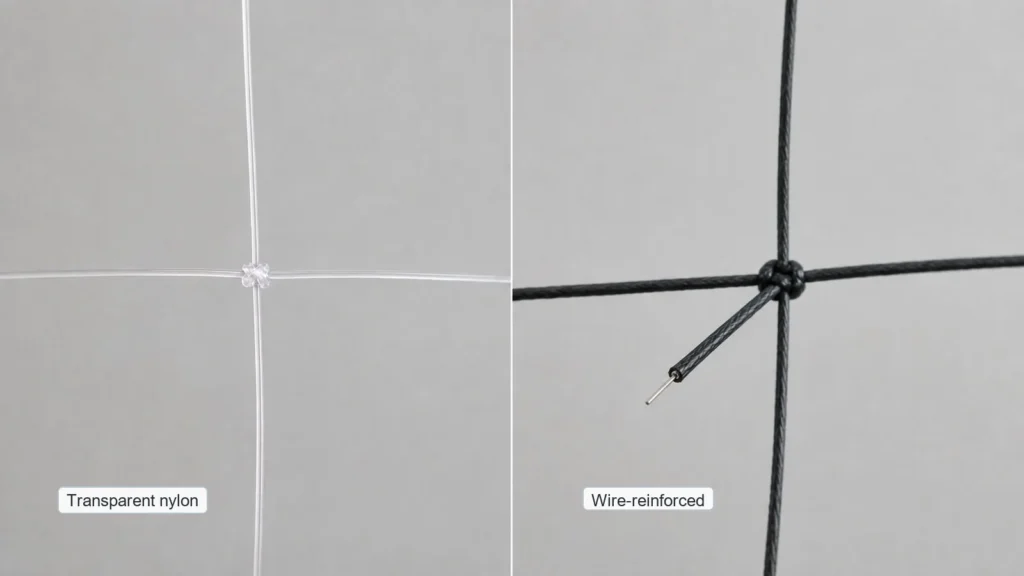
Fixing method and mesh type should be selected together. Transparent nylon net is chosen when the buyer wants a lighter visual effect. Wire-reinforced net is chosen when higher bite resistance is needed. Neither option removes the need for proper installation and regular inspection.
For cats that chew strongly, wire-reinforced net may be more appropriate than transparent nylon. For customers focused on visibility, nylon may be preferred if the cat’s behavior and installation environment are suitable. Avoid absolute claims such as “escape-proof” or “bite-proof.” A more accurate explanation is that the right mesh and fixing method reduce risk when installed and maintained properly.
Cat owners should also consider the indoor environment, activity and supervision. Cats Protection provides general guidance on indoor cats and home environment, which is useful background when planning balcony or window access.
Information Buyers Should Send Before Ordering
A supplier cannot responsibly choose a fixing method from dimensions alone. Photos are required. A good inquiry should include front photos, corner photos, surface close-ups and the desired fixing line.
Send:
- Opening width and height
- Photos of all four edges
- Building surface material
- Whether drilling is allowed
- Mesh preference: transparent nylon or wire-reinforced
- Cat behavior: chewing, climbing, pushing or calm observation
- Whether the installation is temporary or permanent
- Quantity of openings and any repeated sizes
If the buyer is a distributor, standardize the information form. This reduces errors when collecting details from many end customers.
Distributor Kit Planning
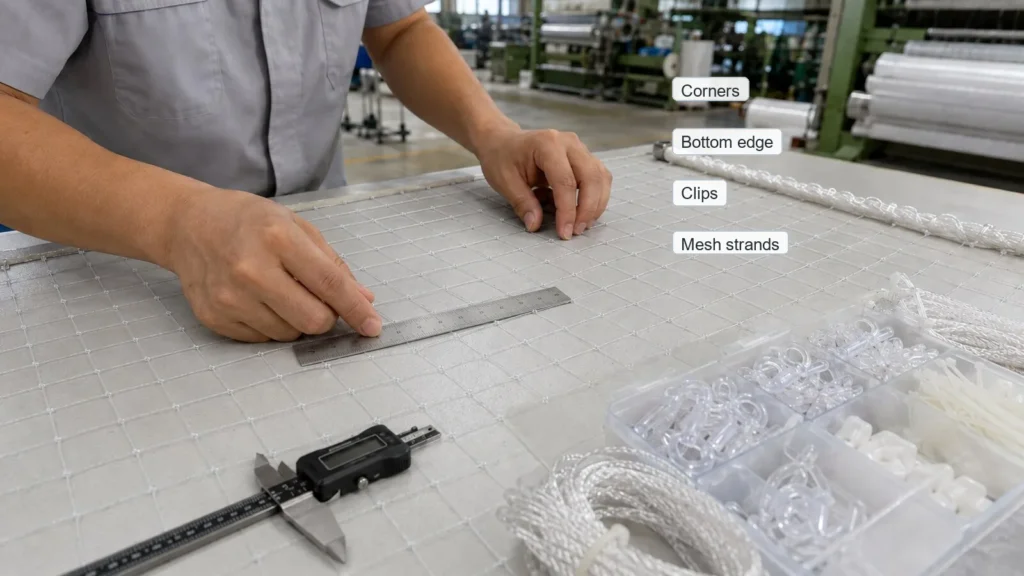
For distributors, cat net installation questions often repeat. A practical product kit can reduce confusion, but it should still be presented honestly. A kit may include mesh, rope, clips, ties and a simple measurement form. It should not imply that the same accessories solve every balcony or window.
If the distributor sells both transparent nylon and wire-reinforced cat net, keep the installation notes separate for each material. A heavier or stiffer mesh may need different handling from a lighter transparent net. Packing the same accessory set with every order may be simple, but it can create waste or missing parts if the opening is unusual.
Useful kit planning details include:
- Mesh type and roll width
- Standard accessory set
- Optional clips or rope
- Measurement form for customer orders
- Clear note on drilling restrictions
- Separate instructions for irregular openings
The most reliable kit is one that helps the customer collect the right information before installation.
Inspection Before Use
After installation, inspect the net before allowing unsupervised balcony or window access. The check should be practical and specific.
Look for:
- Continuous perimeter fixing
- No loose bottom edge
- No corner gap
- No sharp exposed hardware
- Mesh not rubbing against rough surfaces
- Doors and windows opening as expected
- No damaged or cut strands
Regular inspection is also necessary. Weather, cleaning, cat behavior and daily use can change the condition of fixings over time.
Conclusion
No-drill and drilled cat net installation methods both have a place. No-drill fixing is useful when drilling is restricted and the opening provides suitable fixing points. Drilled fixing may be better for permanent installations when the building surface allows it. The correct decision comes from photos, measurements, surface material, cat behavior and edge tension requirements.
If you are planning a balcony or window cat net order, send photos, measurements and fixing restrictions through the MaxCatNet contact page. The mesh and installation method can then be reviewed together instead of treated as separate decisions.
FAQ
Is no-drill cat net installation always safe?
No. It depends on the opening, surface, fixing points and installation quality. No-drill methods should be checked case by case.
When is drilled installation better?
Drilled installation may be better for long-term use, larger openings or surfaces where permanent anchors are allowed and appropriate.
Can transparent nylon cat net use no-drill fixing?
In some openings, yes. The fixing method depends on surface and tension, not only the mesh material.
Is wire-reinforced cat net necessary for every cat?
No. It is often chosen for higher bite resistance, but the right material depends on cat behavior, appearance preference and installation conditions.
What photos should I send before ordering?
Send a full front view, close-ups of each edge and corner, fixing surface details and any door, window or railing areas that may affect installation.