Cat net maintenance starts after installation. A net that looked correct on day one still needs periodic inspection, especially on balconies, windows and other openings exposed to sun, wind, dust, pets and daily household use. Maintenance does not turn a weak installation into a safe one, but it helps buyers and installers notice wear, loose edges or unsuitable fixing before small issues become bigger problems.
MaxCatNet’s current product scope includes Transparent Nylon Cat Protection Net and Stainless Steel Wire-Reinforced Cat Net. Both products need a practical maintenance plan. Nylon mesh, wire-reinforced mesh, hooks, ropes, clips and edge fixings should be checked as a system, not as isolated parts.
Why Cat Net Maintenance Matters
Cat safety nets are often installed in locations that are easy to forget after daily life returns to normal. The net becomes part of the balcony or window background. That is convenient, but it also means damage can be missed.
Regular maintenance helps identify:
- Loose corner fixings
- Mesh sections pulled out of shape
- Worn rope or edge tension
- Broken clips, hooks or ties
- Dirt buildup that hides damage
- Changes caused by weather exposure
- Gaps created by moving furniture or plants
The goal is not to promise absolute safety. Cats Protection notes that balconies and windows can attract cats, but they also present fall and escape risks if access is not properly managed. Their advice includes using suitable netting or screens and supervising cats on balconies. A maintenance plan should follow the same careful mindset: the net is one layer of protection, not a reason to ignore the cat or the installation.
Maintenance Is Different From Installation
Installation asks, “Can this opening be covered correctly?” Maintenance asks, “Is it still covered correctly after use?” These are different questions.
An installation can be correct at the beginning and still need later adjustment. A door may rub against the net. A child may pull a rope. Sunlight may make old plastic clips brittle. A cat may climb the same corner repeatedly. Cleaning work, plant pots, seasonal wind or building repairs can also affect the edge.
Buyers and installers should define who is responsible for inspection. For retail kits, the end user may need a simple checklist. For B2B installation projects, the installer may provide inspection intervals, replacement parts and after-sales guidance. For distributors, clear maintenance instructions reduce misunderstanding and make the product easier to support.
Transparent Nylon Cat Net Maintenance
Transparent nylon cat net is often chosen because it is visually discreet. The same feature can make inspection harder. Fine transparent monofilament may not show damage clearly from a distance, so buyers should inspect it in good light and from more than one angle.
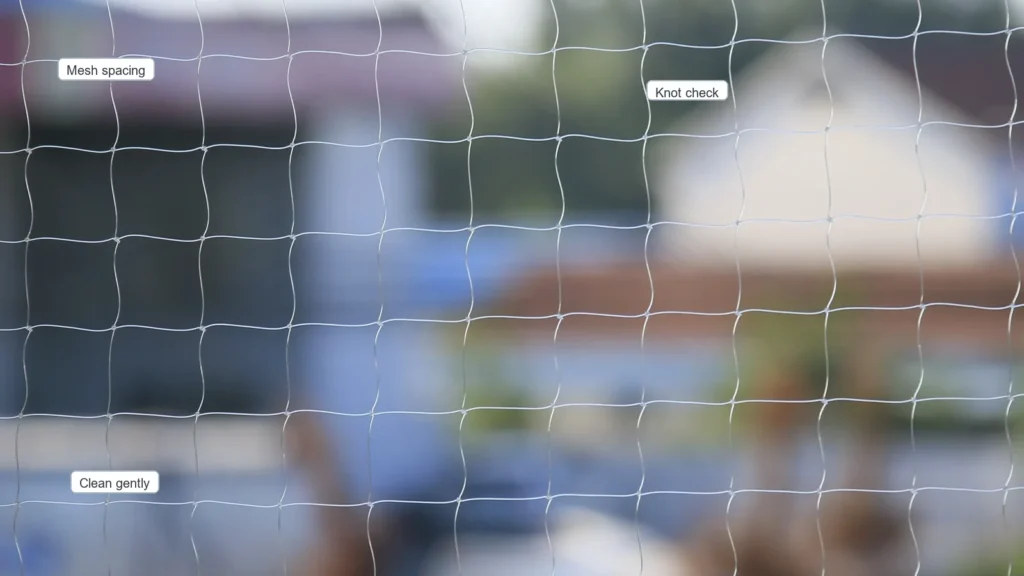
For transparent nylon net, check:
- Whether the mesh remains evenly spaced
- Whether any strand is cut, stretched or frayed
- Whether knots or intersections remain stable
- Whether dirt or balcony dust hides damage
- Whether the net has been pulled loose at the edge
- Whether clips or rope have shifted over time
Cleaning should be gentle. Do not use harsh scraping, sharp tools or strong chemicals unless the supplier confirms compatibility. A soft cloth, light dust removal and careful inspection are usually more relevant than aggressive washing. The important point is to avoid damaging fine strands while trying to clean them.
Wire-Reinforced Cat Net Maintenance
Wire-reinforced cat net is used when buyers want stronger bite resistance and deformation resistance than standard nylon mesh. MaxCatNet describes this product as a PE/HDPE rope structure reinforced with stainless steel wire. It should still be inspected because the mesh, coating, edge rope and fixings can all be affected by use.
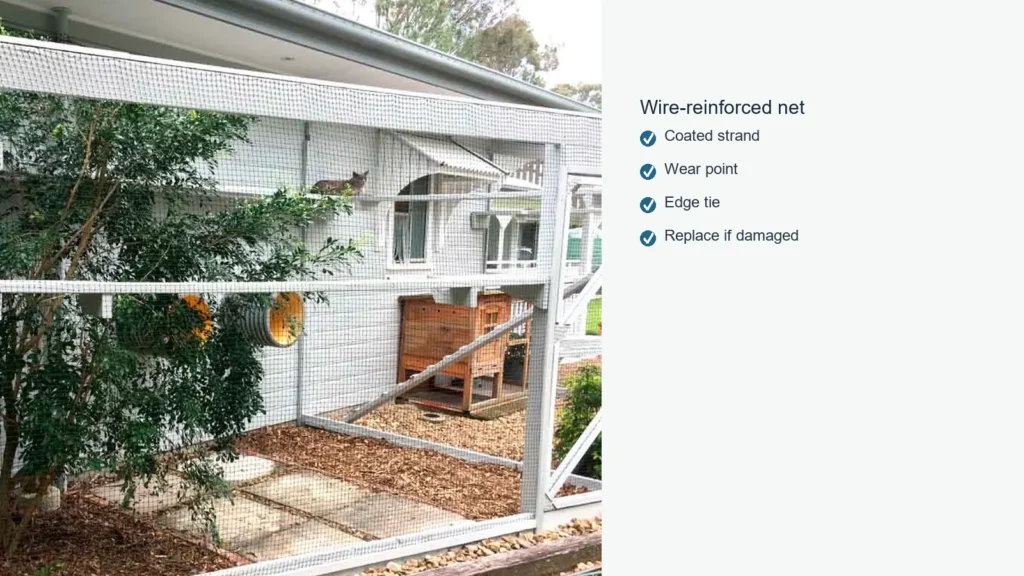
For wire-reinforced net, check:
- Whether the outer coating remains intact
- Whether any strand is crushed, sharply bent or exposed
- Whether the mesh is still square and even
- Whether edges remain tied or fixed correctly
- Whether rubbing points have developed near metal frames
- Whether cable ties, ropes or hooks show fatigue
Wire reinforcement should not be confused with a rigid metal cage. The product is still a flexible net system. If a section is repeatedly bent around a sharp edge, or if the fixing line is overloaded, maintenance should focus on the complete installation rather than only the mesh material.
Fixing Points Deserve the Most Attention
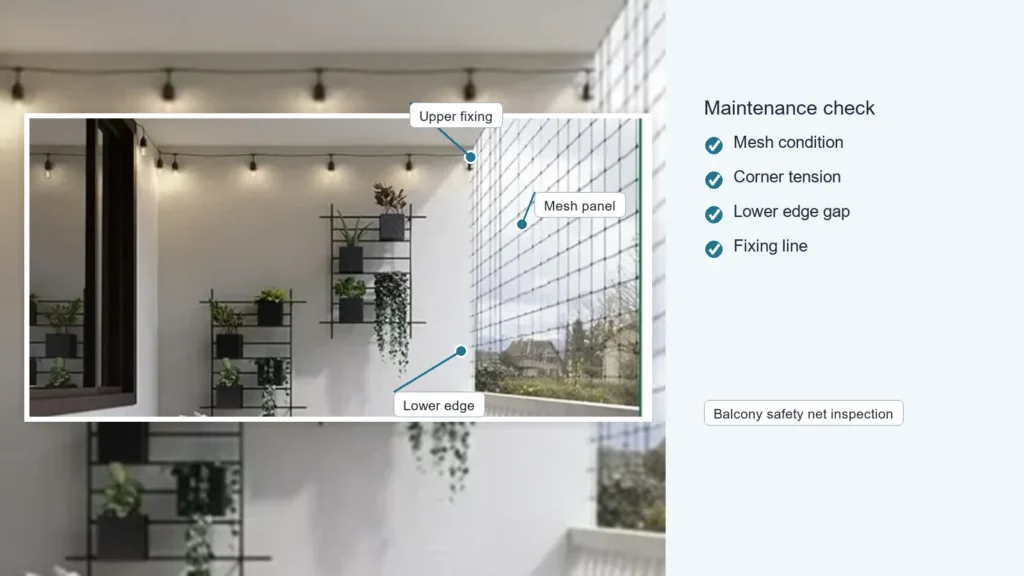
Many real failures do not begin in the middle of the mesh. They begin at the perimeter: a corner, a loose clip, a stretched rope or a gap near a window track. Maintenance should therefore start at the edge.
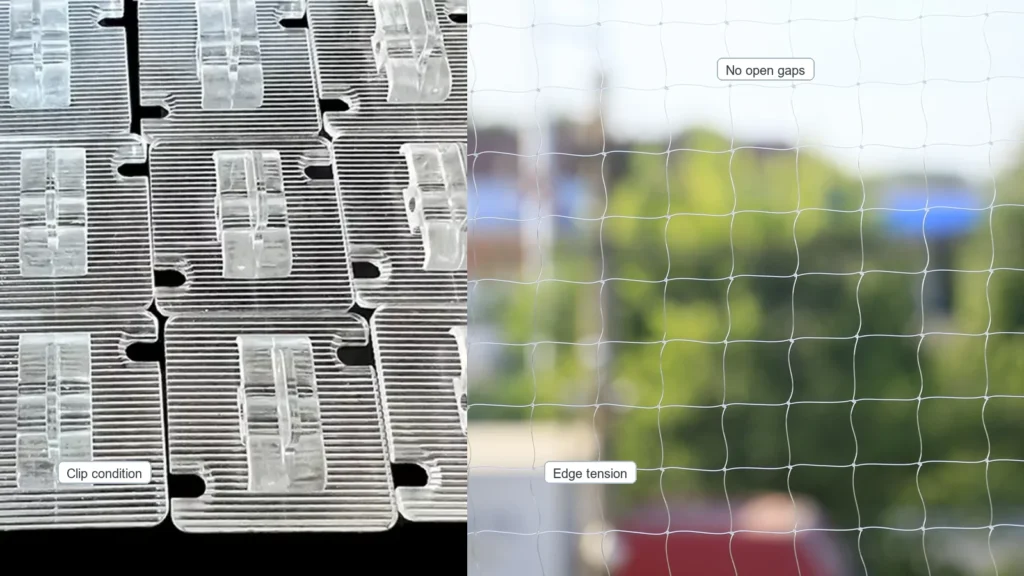
Inspect:
- Top edge
- Bottom edge
- Left and right side edges
- Corners
- Door or sliding window movement areas
- Any point where the net changes direction
- Hooks, clips, dowels, ties, rope and adhesive-backed accessories if used
The edge should not have escape-size gaps. The net should not sag so much that a cat can push under or around it. If furniture is moved near the net, check whether it creates a climbing route that changes how the cat interacts with the mesh. Maintenance is partly about the net and partly about the environment around the net.
Cleaning Without Damaging the Net
Balcony and window installations collect dust, pollen, hair and outdoor residue. Cleaning can improve visibility and make inspection easier, but it should be done carefully.
Practical cleaning guidance:
- Remove loose dust before wiping
- Use soft cloths or gentle brushes
- Avoid sharp scraping near strands
- Avoid pulling the mesh while cleaning
- Do not pressure-wash a delicate installation
- Check corners after cleaning because movement may loosen the edge
If the net is installed in a high-dust or high-pollen environment, inspection after cleaning is more useful than cleaning alone. A clean net with a loose edge is still a problem.
When to Replace a Cat Net
Replacement should be considered when maintenance can no longer restore the installation to a reasonable condition. Do not wait until the net is obviously failing. Replacement planning is especially important for distributors, property projects and installers who support many homes.
Consider replacement when:
- Mesh strands are cut or badly frayed
- Wire-reinforced coating is damaged in repeated areas
- Clips or hooks no longer hold securely
- Rope or ties have become brittle or loose
- The opening has changed after renovation
- The cat’s behavior has changed, such as repeated climbing or chewing
- The net size no longer matches the window or balcony layout
Replacement does not always mean replacing every part. Sometimes the mesh is still usable but accessories need replacement. Sometimes the fixings are fine but the net has been damaged. B2B sellers should help customers identify which parts are replaceable and which require a full new kit.
Maintenance Schedule for Different Users
There is no single schedule that fits every home, climate and cat. A practical schedule should depend on exposure and use.
| Situation | Suggested Maintenance Focus |
|---|---|
| Indoor window installation | Mesh condition, window movement, clip position |
| Balcony installation | Perimeter tension, weather exposure, lower edge gaps |
| High-sun exposure | Nylon strand condition, accessory brittleness, rope condition |
| Active climbing cat | Corners, repeated contact points, edge pulling |
| Wire-reinforced net | Coating condition, bend points, tie strength |
| Rental or temporary installation | Removable fixing points and re-tensioning after movement |
Installers should explain that inspection frequency may increase after storms, renovations, cleaning work or any event that physically touches the net. The best maintenance check is the one that actually happens.
What B2B Buyers Should Include in a Maintenance Kit
A maintenance-friendly product is easier to sell and support. Distributors and installation companies should think beyond the mesh roll.
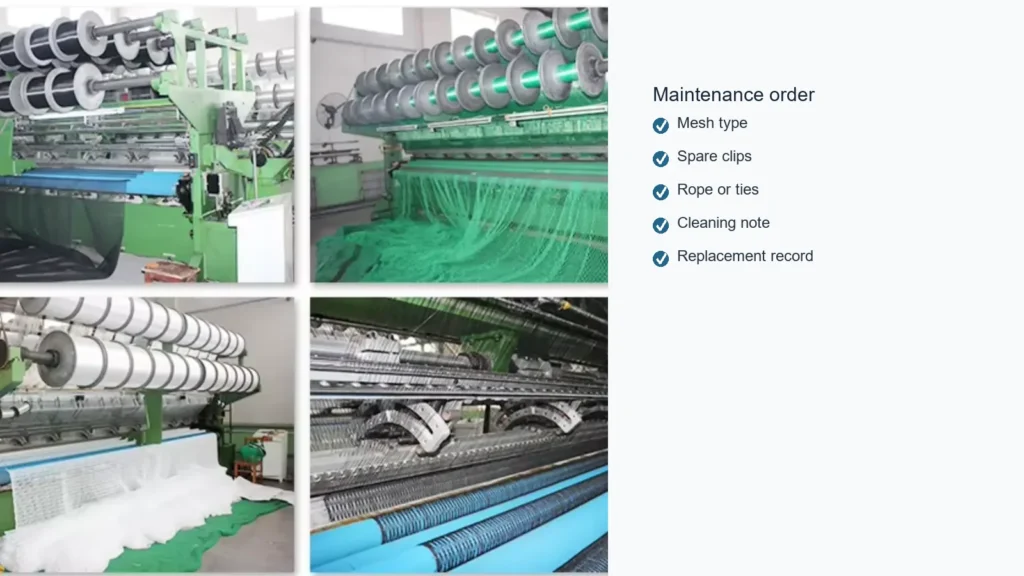
A useful maintenance kit may include:
- Spare clips or hooks
- Matching rope or ties
- Simple inspection card
- Replacement accessory list
- Mesh sample reference
- Cleaning guidance
- Installation contact or support details
For B2B orders, the supplier should also confirm material type, mesh size, color, roll size, accessories and packing. Buyers who manage multiple installation projects should keep order records so replacement parts match the original product.
Common Maintenance Mistakes
The first mistake is checking only the middle of the net. The perimeter is usually more important.
The second mistake is assuming “bite-resistant” means no inspection is needed. Wire reinforcement improves resistance, but fixings, ropes and edges still need checking.
The third mistake is cleaning too aggressively. Pulling, scraping or pressure washing can create damage.
The fourth mistake is ignoring the cat’s behavior. A quiet cat that only sits near the window creates different stress from a cat that climbs, chews or pushes the same corner every day.
The fifth mistake is replacing accessories with mismatched hardware. A strong mesh with weak clips is still a weak system.
Conclusion
Cat net maintenance is a practical part of balcony and window safety planning. Inspect the mesh, edges, fixings, cleaning condition and cat behavior together. Transparent nylon net and wire-reinforced cat net need different inspection attention, but both should be maintained as complete systems.
For B2B buyers, maintenance guidance is also a product quality issue. Clear instructions, spare accessories and replacement planning make the net easier to sell, install and support. To discuss nylon or wire-reinforced net options for your market, contact MaxCatNet through the inquiry page.
FAQ
How often should a cat net be inspected?
Inspection frequency depends on exposure, use and cat behavior. A balcony exposed to weather or an active climbing cat should be checked more often than a lightly used indoor window.
Can transparent nylon cat net be cleaned?
Yes, but cleaning should be gentle. Avoid sharp tools, strong scraping and heavy pulling. Cleaning should be followed by a mesh and edge inspection.
Does wire-reinforced cat net still need maintenance?
Yes. Wire reinforcement improves resistance, but the outer coating, mesh shape, ropes, clips and fixing points still need periodic inspection.
What is the most important area to check?
The perimeter is usually the priority: top edge, bottom edge, sides, corners and any place where the net meets a frame, wall, rail or door.
Should customers replace the whole net or only accessories?
It depends on the damage. If the mesh is intact but clips are worn, accessories may be enough. If strands are cut, coating is damaged or the net no longer fits the opening, replacement should be considered.