
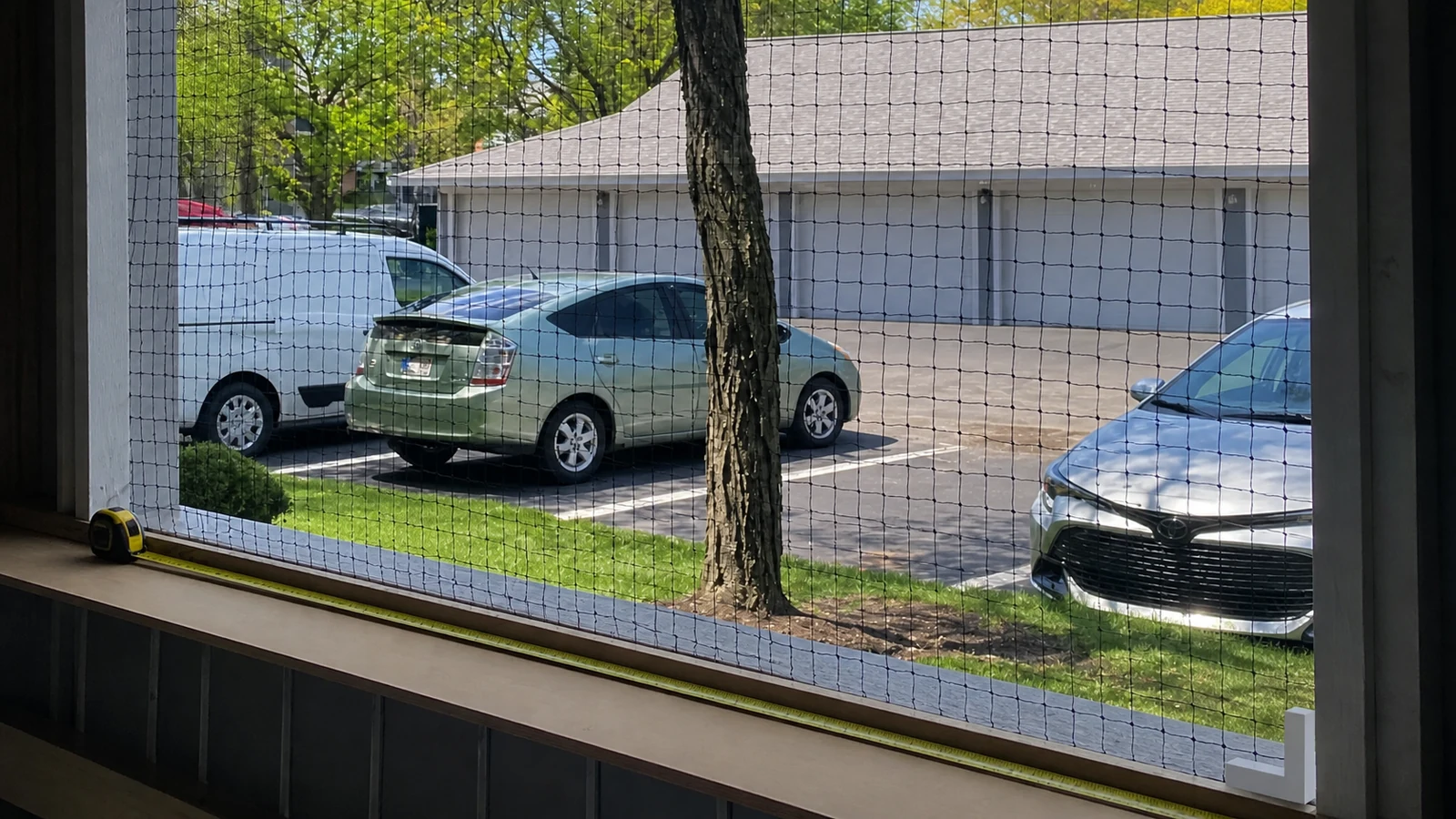
An old cat net can provide useful clues about the opening, but it is not a reliable template by itself. The net may have stretched, been trimmed, repaired, or installed before windows, rails, pipes, and finishes changed. Existing fixings may also need qualified assessment before reuse.
A replacement survey records the current opening first, then maps the old net and perimeter as separate evidence.
Record Why Replacement Is Being Considered
Describe visible changes such as broken strands, coating damage, persistent sag, loose perimeter sections, altered fixtures, renovation, unknown product identity, or owner preference. Photograph the full opening and each concern.
Avoid assigning a service life or failure cause from appearance alone. Exposure, installation, contact, maintenance, and material all need context. The maintenance inspection guide provides a structured condition record.
Keep pets away from any questionable opening until the responsible installer or owner process confirms a safe arrangement.
Identify the Existing Net
Record whether the old net is believed to be transparent nylon, wire-reinforced, or unknown. Photograph strand and mesh close-ups, edge finish, labels, packaging records, invoices, and installation documents.
Avoid relying only on color. Aged, dirty, painted, or sun-exposed material can look different from its original condition.
If identity remains uncertain, label it unknown in the replacement RFQ and request a new product decision.
Remeasure the Current Opening
Use current fixed building references. Measure width and height at several positions, diagonals where relevant, recess depth, rail spacing, and all stepped boundaries. Record units and viewing direction.
Compare with the earlier record, but preserve both values. A difference may result from renovation, measurement method, or the old net's installed shape.
| Survey Layer | Record |
|---|---|
| Current opening | Fixed boundaries and dimensions |
| Existing net | Visible panel size and condition |
| Perimeter line | Cable, frame, or edge route |
| Fixings | Position, type if known, condition |
| Obstacles | Current pipes, drains, rails, handles, screens |
The measurement article supports the opening record.
Map the Existing Perimeter
Start at a marked corner and follow the boundary in one direction. Photograph cable or edge line, corners, terminations, fixing points, tensioning components, and transitions around obstacles.
Note rust, coating damage, loose parts, cracked substrate, enlarged holes, sharp edges, and improvised repairs. Avoid moving hardware during the survey.
The existing route may inspire the new design, yet it does not automatically prove that every point remains suitable.
Review the Supporting Substrate Again
Record current concrete, masonry, metal, rail, frame, coatings, waterproofing, and repairs. Renovation may hide or remove the original structural access.
Ask the qualified installer which existing holes, cables, or fixings can be assessed for reuse and what evidence is required. Building approval may be needed even when the new net follows the old location.
Preserve uncertainty on the drawing. "Fixing type not visible behind trim" is better than an unsupported assumption.
Check Openings and Maintenance Access
Operate windows and doors through their normal paths where safe. Record handles, locks, sliding tracks, insect screens, shutters, drains, cleaning access, and facade maintenance needs.
The old installation may have forced inconvenient workarounds. Replacement is an opportunity to resolve them with the installer rather than copying the same conflict.
Also record furniture and plants that obscure the boundary or prevent access.
Plan Safe Removal and Temporary Control
Removal can expose the balcony or window before the replacement is complete. Define who removes the old system, how the area is controlled, where pets stay, and how loose strands and sharp hardware are handled.
Avoid removing the old net simply to obtain a flat measurement unless the installer has planned temporary protection and access.
Photograph the perimeter again after removal. Hidden substrate condition may change the proposal.
Decide the New Product Independently
Review transparent nylon and wire-reinforced options using the current household, cat behavior, visibility preference, environment, installation, and maintenance plan. The material comparison explains the distinction without absolute claims.
The previous material does not have to be repeated. Conversely, changing material can affect appearance, handling, edge details, and quotation.
State the new product identity clearly and keep old-net observations as background evidence.
Approve a New Perimeter Plan
Ask the installer to mark reused, replaced, added, and removed components. Record substrate preparation, finish protection, corner treatment, obstacle routing, inspection points, and maintenance access.
If existing components remain, identify who assessed them and under which criteria. Avoid using the phrase "all old fixings good" without a visible schedule.
Update dimensions after any substrate repair that changes the opening.
Close the Replacement Record
Keep before, during, and after photographs; old product identity; removal notes; current measurements; installer assessment; new material specification; perimeter drawing; fixing schedule; open issues; and handover date.
Dispose of old material and sharp components according to local rules and contractor procedures. Retain a labeled sample only when it is safe and useful for the record.
Use the new installation photos as the maintenance baseline rather than continuing to compare against the deteriorated panel.
Reconcile the Replacement Quotation
The final quotation should separate new net material, perimeter components, assessed reusable items, removal, access equipment, substrate repair, temporary opening control, disposal, and handover records. Mark exclusions clearly. This prevents the buyer from comparing a material-only offer with an installed replacement scope and helps the installer identify which site uncertainties still require a visit or building approval.
Related Reading
- Cat Net Maintenance Inspection helps document the old condition.
- Nylon vs Wire-Reinforced Cat Net supports the new material decision.
Common Questions
Can the old net dimensions be copied?
Use them as background only. Remeasure the current fixed opening and record any difference.
Can existing fixings remain?
Qualified assessment, current substrate condition, system design, and building permission determine reuse.
Should the old net be removed before quotation?
Often the visible system can be surveyed first. Removal needs a plan for access and temporary opening control.
Can the replacement use a different material?
Yes, after product identity, appearance, installation, household needs, and maintenance are reviewed as a new decision.
Request a Replacement Review
Use the MaxCatNet contact page to send current opening measurements, old net identity, full boundary photos, fixing and substrate condition, building changes, access needs, and preferred new material. Treat the existing system as evidence, not as an unquestioned template.