
A multi-opening cat-net order contains more than mesh. Depending on the approved system, each opening may require perimeter components, connection pieces, fixings, edge finishing, labels, templates, or other identified parts. If everything is placed in one general accessory carton, the first installation can consume parts intended for later units and hide a packing shortage. Opening-level reconciliation gives each panel a bill of materials, separates approved spare stock, and makes substitutions visible before the installer is standing at the boundary.
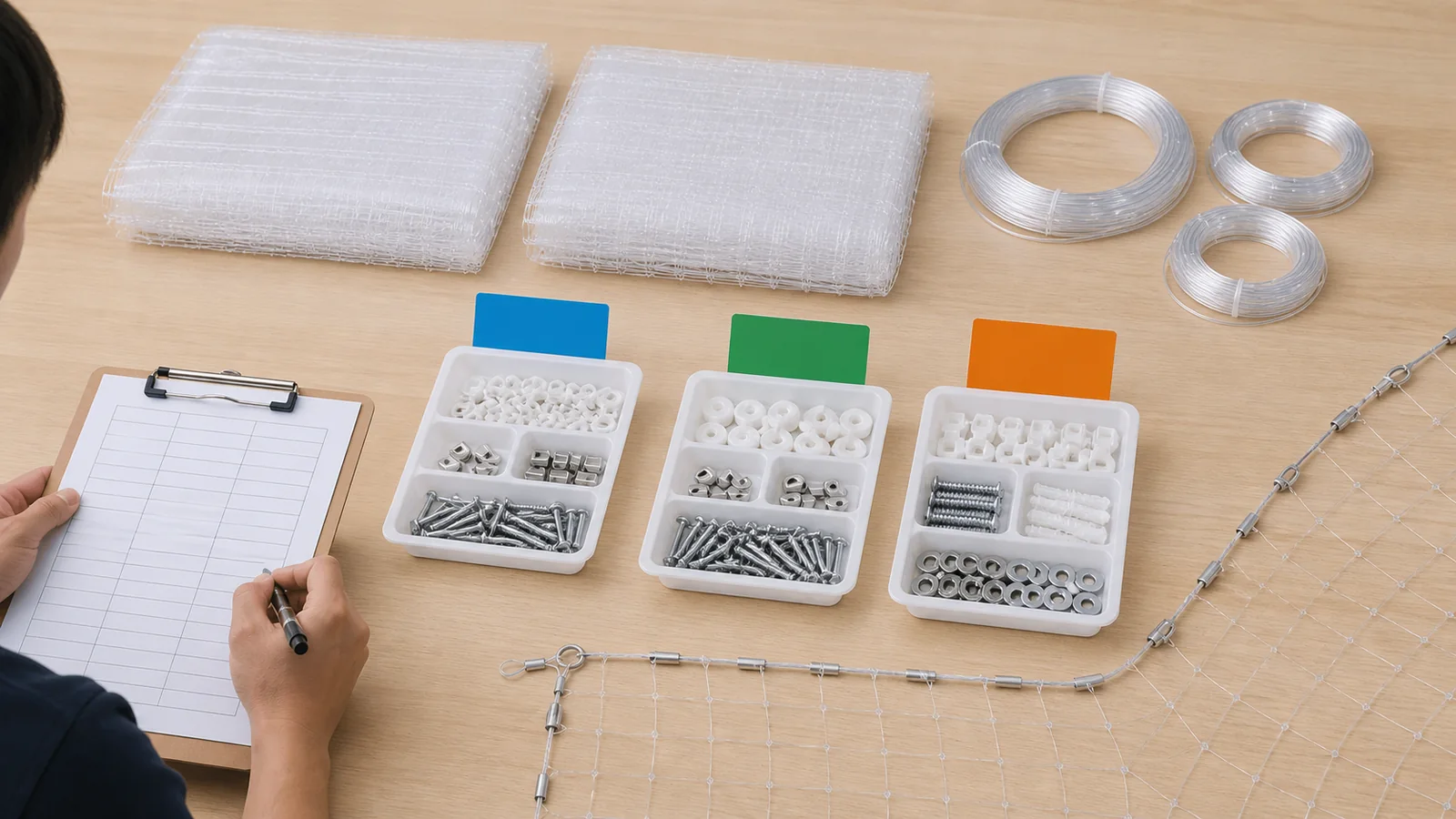
Start From the Released Opening Schedule
the accessory list uses the same opening ID, panel revision, installation method, and measured geometry as production. For this cat net accessory reconciliation by opening task, the responsible team should freeze the released schedule and create a line for every panel, perimeter segment, approved fixing family, connector, label, and special detail. The check belongs at the point where the physical condition and its identity can still be verified together.
At the start from the released opening schedule stage, retain drawing revision, opening ID, panel dimensions, method, component description, planned quantity, and pack group. Link each photograph, count, mark, drawing, or note to the cat net accessory reconciliation by opening item it describes, including the current location and responsible role where those facts matter.
Accessory planning cannot repair an unresolved survey or fixing decision. That boundary governs cat net accessory reconciliation by opening, not a different product or site. When evidence supports more than one interpretation, record the uncertainty and route it to the qualified decision owner.
Close start from the released opening schedule only when every opening has an approved component baseline. If open, preserve the cat net accessory reconciliation by opening state and name the unresolved point, owner, next evidence, and hold or follow-up action before physical custody or project work changes.
Before moving on, compare drawing revision, opening ID, panel dimensions, method, component description, planned quantity, and pack group with the release condition: every opening has an approved component baseline. This final comparison gives the cat net accessory reconciliation by opening handoff enough context for the next buyer, supplier, warehouse, installer, operator, or project reviewer to act without rebuilding the chronology.
Distinguish Opening Parts From Shared Tools
consumable or installed components are separated from reusable tools, access equipment, templates, and general site supplies. For this cat net accessory reconciliation by opening task, the responsible team should classify each item by ownership, destination, return requirement, compatibility, and whether it remains in the finished installation. The check belongs at the point where the physical condition and its identity can still be verified together.
At the distinguish opening parts from shared tools stage, retain component code, description, image where useful, opening allocation, tool custody, and approved spare category. Link each photograph, count, mark, drawing, or note to the cat net accessory reconciliation by opening item it describes, including the current location and responsible role where those facts matter.
Visual resemblance is insufficient when fixings or connectors differ by substrate or system. That boundary governs cat net accessory reconciliation by opening, not a different product or site. When evidence supports more than one interpretation, record the uncertainty and route it to the qualified decision owner.
Close distinguish opening parts from shared tools only when packer and installer use the same component vocabulary. If open, preserve the cat net accessory reconciliation by opening state and name the unresolved point, owner, next evidence, and hold or follow-up action before physical custody or project work changes.
Before moving on, compare component code, description, image where useful, opening allocation, tool custody, and approved spare category with the release condition: packer and installer use the same component vocabulary. This final comparison gives the cat net accessory reconciliation by opening handoff enough context for the next buyer, supplier, warehouse, installer, operator, or project reviewer to act without rebuilding the chronology.
Pack and Label at the Smallest Useful Unit
the installer can identify the correct accessory group before opening the panel or mixing components at site. For this cat net accessory reconciliation by opening task, the responsible team should place opening-specific parts in sealed or controlled subpacks and label them with project, opening, revision, package count, and any handling note. The check belongs at the point where the physical condition and its identity can still be verified together.
At the pack and label at the smallest useful unit stage, retain packing photograph, subpack label, quantity, checker, main package, and destination sequence. Link each photograph, count, mark, drawing, or note to the cat net accessory reconciliation by opening item it describes, including the current location and responsible role where those facts matter.
Color alone should not be the only identifier. That boundary governs cat net accessory reconciliation by opening, not a different product or site. When evidence supports more than one interpretation, record the uncertainty and route it to the qualified decision owner.
Close pack and label at the smallest useful unit only when each opening pack can be counted without disturbing another. If open, preserve the cat net accessory reconciliation by opening state and name the unresolved point, owner, next evidence, and hold or follow-up action before physical custody or project work changes.
Before moving on, compare packing photograph, subpack label, quantity, checker, main package, and destination sequence with the release condition: each opening pack can be counted without disturbing another. This final comparison gives the cat net accessory reconciliation by opening handoff enough context for the next buyer, supplier, warehouse, installer, operator, or project reviewer to act without rebuilding the chronology.
Opening-Level Accessory Reconciliation
The same matrix follows components from released plan through packing, site transfer, installation, and leftover disposition.
| Review Point | Evidence | Hold or Release Question |
|---|---|---|
| Released need | Opening ID, revision, method and component list | Is the baseline approved? |
| Packed quantity | Subpack label, count, checker and main package | Can it be verified unopened? |
| Site change | Transfer or substitution request and approval | Are both opening balances protected? |
| Closeout | Installed, spare, returned, damaged and uncertain items | Is every important balance explained? |
Reconcile at Dispatch and Site Receipt
the planned, packed, dispatched, and received quantities remain separate fields instead of one final total. For this cat net accessory reconciliation by opening task, the responsible team should use two-stage checking for high-risk similar components and record package condition before accessories move into unit-level storage. The check belongs at the point where the physical condition and its identity can still be verified together.
At the reconcile at dispatch and site receipt stage, retain packing list, checker signatures, seal status, shortages, overages, damage, receiving location, and custody. Link each photograph, count, mark, drawing, or note to the cat net accessory reconciliation by opening item it describes, including the current location and responsible role where those facts matter.
A total project count cannot prove that every opening has the right allocation. That boundary governs cat net accessory reconciliation by opening, not a different product or site. When evidence supports more than one interpretation, record the uncertainty and route it to the qualified decision owner.
Close reconcile at dispatch and site receipt only when site receipt confirms each opening group and shared item. If open, preserve the cat net accessory reconciliation by opening state and name the unresolved point, owner, next evidence, and hold or follow-up action before physical custody or project work changes.
Before moving on, compare packing list, checker signatures, seal status, shortages, overages, damage, receiving location, and custody with the release condition: site receipt confirms each opening group and shared item. This final comparison gives the cat net accessory reconciliation by opening handoff enough context for the next buyer, supplier, warehouse, installer, operator, or project reviewer to act without rebuilding the chronology.
Control Borrowing and Substitution
an installer shortage at one opening does not silently consume another opening's allocation or an unapproved local component. For this cat net accessory reconciliation by opening task, the responsible team should issue a transfer record naming donor and receiving openings, part identity, quantity, reason, technical approval, and replenishment action. The check belongs at the point where the physical condition and its identity can still be verified together.
At the control borrowing and substitution stage, retain before and after balances, approver, installation status, affected appointments, and replacement dispatch. Link each photograph, count, mark, drawing, or note to the cat net accessory reconciliation by opening item it describes, including the current location and responsible role where those facts matter.
Commercial availability cannot establish compatibility or fixing adequacy. That boundary governs cat net accessory reconciliation by opening, not a different product or site. When evidence supports more than one interpretation, record the uncertainty and route it to the qualified decision owner.
Close control borrowing and substitution only when every transfer is approved and both opening balances remain correct. If open, preserve the cat net accessory reconciliation by opening state and name the unresolved point, owner, next evidence, and hold or follow-up action before physical custody or project work changes.
Before moving on, compare before and after balances, approver, installation status, affected appointments, and replacement dispatch with the release condition: every transfer is approved and both opening balances remain correct. This final comparison gives the cat net accessory reconciliation by opening handoff enough context for the next buyer, supplier, warehouse, installer, operator, or project reviewer to act without rebuilding the chronology.
Close Leftovers and Spare Stock
unused parts are identified as approved spare, returned overage, obsolete revision, damaged item, or unexplained balance. For this cat net accessory reconciliation by opening task, the responsible team should count after installation, compare with the opening record, label retained spares by system and project, and quarantine uncertain items. The check belongs at the point where the physical condition and its identity can still be verified together.
At the close leftovers and spare stock stage, retain installed quantity where recorded, unused identity, location, owner, expiry or condition if relevant, and disposition. Link each photograph, count, mark, drawing, or note to the cat net accessory reconciliation by opening item it describes, including the current location and responsible role where those facts matter.
Loose anonymous components should not enter a future project. That boundary governs cat net accessory reconciliation by opening, not a different product or site. When evidence supports more than one interpretation, record the uncertainty and route it to the qualified decision owner.
Close close leftovers and spare stock only when project closeout explains every material balance that matters. If open, preserve the cat net accessory reconciliation by opening state and name the unresolved point, owner, next evidence, and hold or follow-up action before physical custody or project work changes.
Before moving on, compare installed quantity where recorded, unused identity, location, owner, expiry or condition if relevant, and disposition with the release condition: project closeout explains every material balance that matters. This final comparison gives the cat net accessory reconciliation by opening handoff enough context for the next buyer, supplier, warehouse, installer, operator, or project reviewer to act without rebuilding the chronology.
Buyer Checklist
- Build accessory demand from the released opening revision.
- Separate installed parts from shared tools and supplies.
- Use names or codes that distinguish similar components.
- Pack and label by opening where practical.
- Record planned, packed, dispatched, and received quantities.
- Approve all inter-opening transfers and substitutions.
- Identify and disposition leftovers instead of pooling them anonymously.
Frequently Asked Questions
Should every fixing be packed separately by opening?
Use the level of segregation needed for the approved system, project risk, installation sequence, and practical counting. The allocation must remain traceable even when some items are shared.
Can an installer borrow from the next unit?
Only through an approved transfer that protects both opening balances and confirms technical compatibility.
What counts as spare stock?
Spare status should be planned or formally approved, clearly identified, compatible with the released system, stored under known custody, and separated from unexplained leftovers.
Related Product or Reading
Pair the accessory register with cut-panel identification for multi-opening projects so mesh and parts travel under one opening identity.
Discuss the Exact Project
Send MaxCatNet the opening schedule, panel revisions, approved installation method, substrate notes, component list, pack sequence, spare policy, site receiving plan, and installer appointment order.