
Cat net installation is not only a question of mesh size. The fixing plan needs to cover the opening, its edges and the way doors or windows move. For balconies and windows, buyers usually compare no-drill fixing and drilled fixing.
Neither method is suitable for every site. Start with the surface, permission to alter it, the opening layout and the instructions for the proposed net and fixings. A permanent installation still needs a suitable design; a removable installation still needs a complete boundary.
MaxCatNet’s product families include transparent nylon monofilament netting and HDPE mesh with wire reinforcement. Identify the net being quoted before confirming its fixing arrangement.
What No-Drill Cat Net Installation Means
No-drill installation means fixing the net without drilling into the wall, ceiling, frame or railing. A proposed system may use clips, ties, an existing rail or a separate frame. The supplier or installer needs to identify which arrangement fits the actual opening.
No-drill does not automatically mean damage-free or suitable for a rental property. If adhesive or removable fittings are proposed, ask about the exact surface, preparation, curing instructions and removal method. Paint, tile, metal, glass and rough masonry need to be identified in the site description. Permission and restoration questions are covered in the rental balcony planning guide.
Before considering a no-drill proposal, confirm:
- Whether drilling is prohibited or simply not preferred.
- The material and visible condition of each fixing surface.
- The opening’s size, shape, corners and upper boundary.
- How every edge will meet the proposed support or fixing line.
- Which doors, windows or handles need to move.
- Whether the cat climbs, chews or pushes the mesh.
What Drilled Installation Means
Drilled installation uses anchors, hooks, screws or brackets installed into a suitable substrate. The method name alone does not establish the anchor type, fixing depth, spacing or load capacity. Those details belong to the specified system and the installer’s assessment.
Before drilling, confirm permission and have the installer assess the proposed locations, including concealed services, surface condition and waterproofing. A railing or window frame should not be assumed suitable merely because it can be drilled.
| Method | Question to resolve | What the plan should identify |
|---|---|---|
| No-drill fixing | Are the proposed surfaces and attachment points suitable? | Exact fittings, surface requirements, removal and edge coverage. |
| Drilled fixing | Is drilling permitted, and is the substrate suitable? | Anchor specification, locations and installation instructions. |
| Mixed fixing | Can different fixing arrangements form one complete boundary? | Each edge’s method and the transitions between them. |
| Separate frame | Can an independently supported frame suit this opening? | Frame support, attachment, fit and any removal requirements. |
When a Mixed Fixing Plan Is More Realistic
Many openings do not have the same surface on every side. One edge may meet concrete, another aluminium, and the bottom a railing or sliding-door track. A mixed proposal needs an edge-by-edge description rather than a single label such as “no-drill”.
Mark where the fixing method changes and ask the installer how the net, rope or support meets at that point. Include corners, pipes, handles and any route above or around the panel. Photos and these notes give the reviewer information that a width and height alone cannot provide.
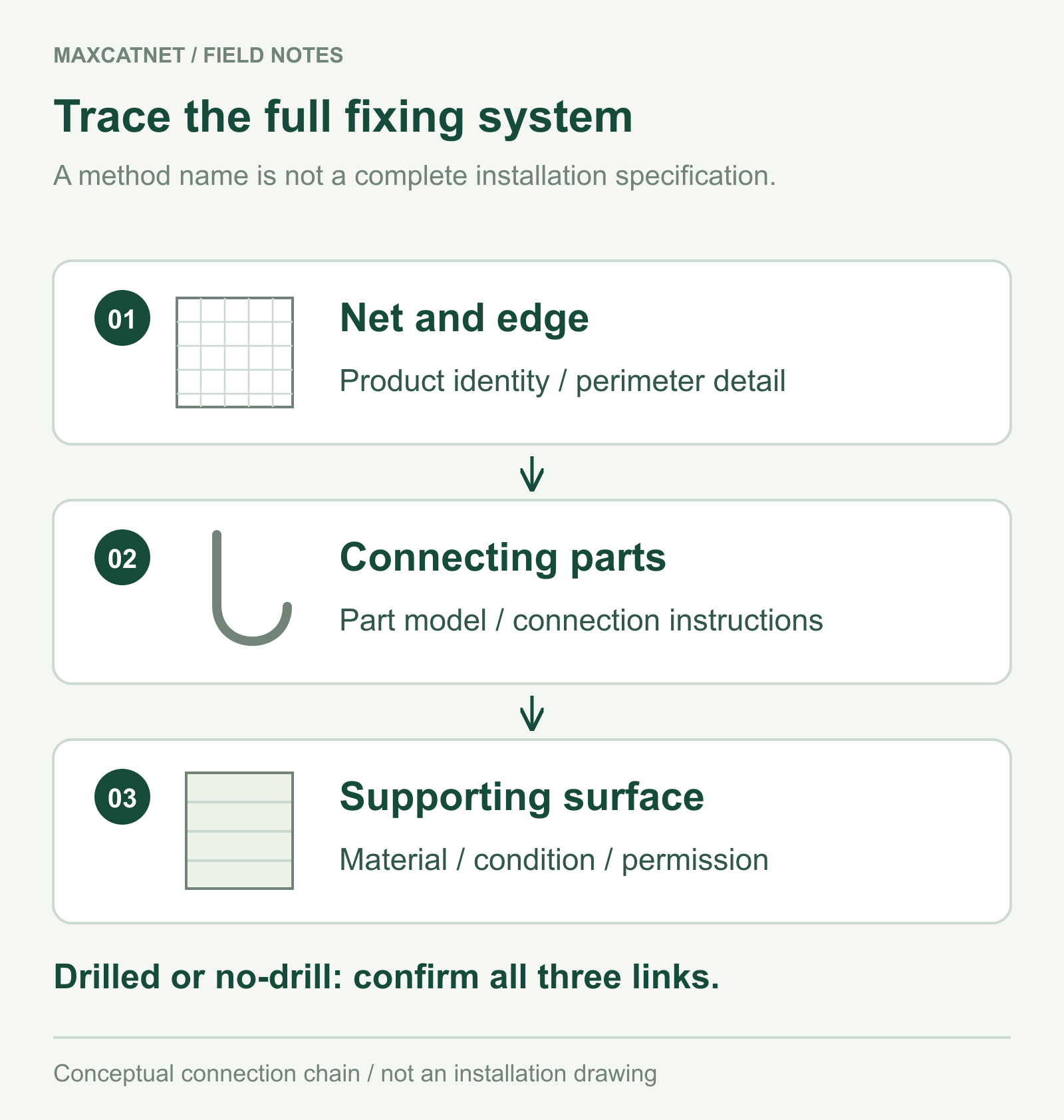
Set the Perimeter to the Product’s Instructions
Review the top, bottom, sides and corners together. Confirm how the proposed system controls edge gaps, meets adjoining structures and accommodates window movement. Tightening the mesh further is not a general answer to an unresolved boundary or attachment problem.
Instructions can differ by product. For example, TRIXIE’s instructions for models 44303/44313/44323/44333/44343 call for slight sag in the installed net. That is guidance for those models, not a tension setting for MaxCatNet products or another installation. Obtain the directions for the exact net and fixing system.
Keep detailed tension questions with the tension and sag acceptance guide. This comparison does not set a universal fixing interval, amount of sag or pull-test force.
Review the Mesh and Fixing Together
Identify the net’s material, dimensions, edge finish and handling instructions in the proposal. Record the cat’s behaviour and the site’s appearance requirements, then ask the supplier which product and fixing options it can document.
Wire reinforcement does not establish that a net is bite-proof, nor does it select an anchor or make an incomplete opening suitable. Transparent nylon also needs its own confirmed fixing arrangement. Review the quoted product and complete installation rather than choosing solely from the material name.
Information Buyers Should Send Before Ordering
Send a front view, close-ups of each edge and corner, the surface details and a marked proposed fixing line. Include:
- Opening dimensions and any changes in level or shape.
- The upper boundary, railing gaps and adjoining structures.
- Drilling permission and any removal restrictions.
- Door and window opening positions.
- The proposed net specification and observed cat behaviour.
- The number of openings and any repeated layouts.
Keep the measured opening separate from the finished net dimensions. The balcony measurement guide explains the site record. Distributors can use the same information form across enquiries while keeping each opening’s differences visible.
Keep the Accessory List With the Fixing Plan
Once a method is proposed, identify the accessories and instructions that go with it. Do not assume a photograph or a generic kit name defines the contents. The accessory-kit planning guide covers component identity, quantities and packing checks.
This page compares methods; the accessory list records what is actually included. Keep both with the same opening and quotation reference so substitutions or omissions can be discussed before installation.
Inspection Before Use
Check the finished installation against its agreed plan and instructions. Review:
- Coverage of the whole opening, including its upper boundary.
- Bottom edges, corners and changes between fixing methods.
- Fixings and net edges against the specified arrangement.
- Exposed hardware, damaged strands and rubbing points.
- Door and window movement through their intended positions.
Keep the cat away from the opening while defects or unanswered installation questions remain. An inspection does not make unattended balcony access appropriate. Cats Protection advises supervising cats on balconies and restricting access if a cat appears frustrated or eager to escape.
Keep the instructions and photographs for later checks. The maintenance and inspection guide covers changes after cleaning, weather exposure and daily use.
Common Fixing-Method Questions
Is no-drill cat net installation always suitable?
No. Suitability depends on the opening, surfaces, specified fittings and complete installation. No-drill also needs confirmation of permission and removal requirements.
When should drilled fixing be considered?
Consider it when drilling is permitted and an installer has assessed the substrate and proposed anchors. Permanence or opening size alone does not make it the better method.
Can transparent nylon netting use no-drill fixing?
Ask about a documented arrangement for the exact net and site. The word “nylon” does not establish clip, adhesive or surface compatibility.
Does wire reinforcement decide the fixing method?
No. The specified net, supports, attachments and opening must be reviewed together. Reinforcement is not proof of a complete or suitable installation.
What photos should I send?
Send the full opening, every edge and corner, surface close-ups and the door or window in its opening positions. Mark the proposed fixing line and any restrictions.
Request a Fixing-Plan Review
Send MaxCatNet your opening photos and fixing requirements, with dimensions, permission limits, proposed net and quantity. Ask which product and accessory details can be confirmed for that proposal, and which site decisions need the installer.