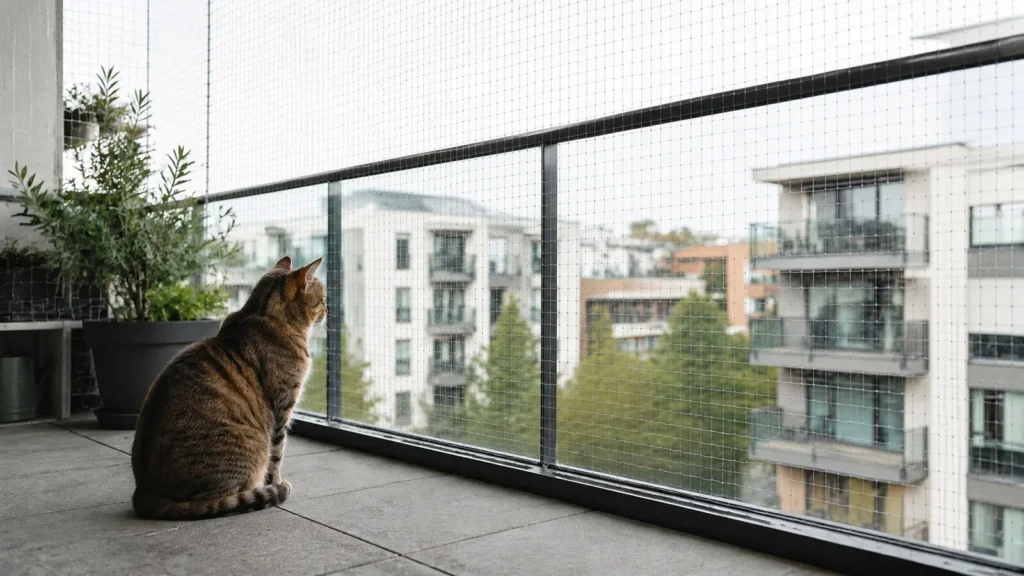
Yes, a determined cat can damage some types of safety netting, especially if the material is thin, already weathered, poorly tensioned or repeatedly chewed in the same place. However, this does not mean every cat needs a metal-core net.
For many calm adult cats, a good-quality, UV-stabilized nylon cat net is a practical and discreet barrier. For persistent chewers, strong climbers, large cats or multi-cat homes, a stainless steel wire-reinforced cat net usually provides a greater margin of resistance.
The important distinction is bite-resistant, not indestructible. No flexible cat net should be treated as impossible to damage, and even the strongest mesh depends on secure edges, suitable anchors and regular inspection.
This guide explains how cats damage netting, how nylon and wire-reinforced products compare, and how pet owners, retailers and professional installers can choose the appropriate construction.
Why Do Some Cats Chew or Claw Cat Netting?
Many cats never show sustained interest in a properly installed net. Others may test it with their teeth or claws for several reasons:
- Kittens explore unfamiliar objects with their mouths and paws.
- An active cat may climb the mesh while following a bird or insect.
- A frustrated cat may repeatedly work at an edge or gap while trying to escape.
- Loose strands can move like a toy and attract chewing.
- A cat that already chews cords, plants or fabric may also target netting.
- In a multi-cat household, play or chasing can place sudden loads on the barrier.
Repeated chewing should not be ignored. It can weaken the net and may create loose material that could be swallowed. If chewing is frequent, unusual or extends to other non-food objects, the owner should also discuss the behaviour with a veterinarian.
What Determines Whether a Cat Can Damage the Net?
The material name alone does not answer the question. Two products both described as “nylon cat nets” can perform very differently. The following factors matter more than a simple nylon-versus-wire label.
1. Material and Strand Construction
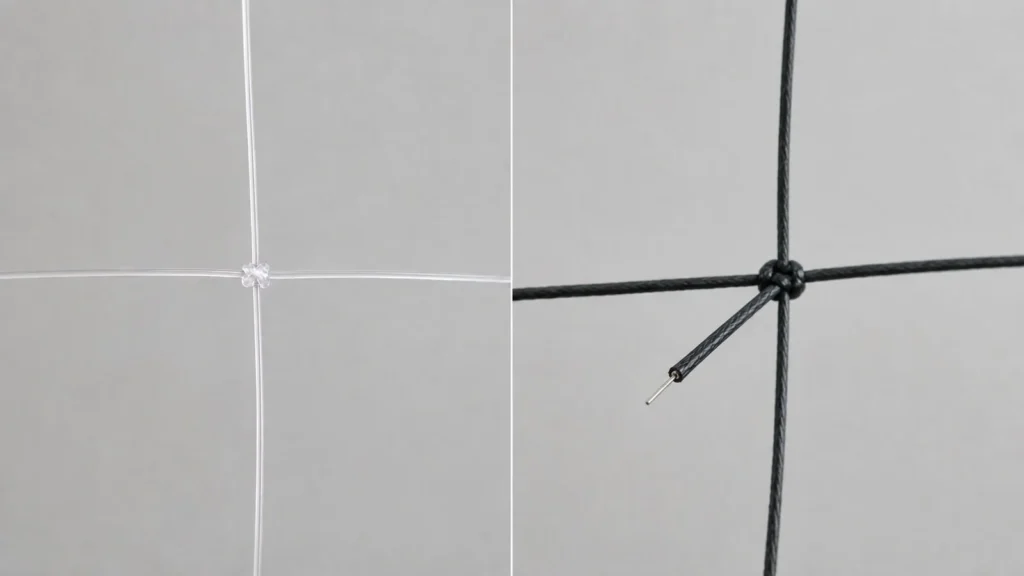
Virgin, UV-stabilized nylon monofilament generally offers more consistent outdoor performance than low-grade recycled material. A wire-reinforced product combines an outer polymer strand with an internal stainless steel component, so a cat must work through more than a single plastic filament.
The construction should be confirmed from a physical sample or specification sheet. Product photos alone rarely show the core clearly.Yes, a determined cat can damage some types of safety netting, especially if the material is thin, already weathered, poorly tensioned or repeatedly chewed in the same place. However, this does not mean every cat needs a metal-core net.
For many calm adult cats, a good-quality, UV-stabilized nylon cat net is a practical and discreet barrier. For persistent chewers, strong climbers, large cats or multi-cat homes, a stainless steel wire-reinforced cat net usually provides a greater margin of resistance.
The important distinction is bite-resistant, not indestructible. No flexible cat net should be treated as impossible to damage, and even the strongest mesh depends on secure edges, suitable anchors and regular inspection.
This guide explains how cats damage netting, how nylon and wire-reinforced products compare, and how pet owners, retailers and professional installers can choose the appropriate construction.
Why Do Some Cats Chew or Claw Cat Netting?
Many cats never show sustained interest in a properly installed net. Others may test it with their teeth or claws for several reasons:
- Kittens explore unfamiliar objects with their mouths and paws.
- An active cat may climb the mesh while following a bird or insect.
- A frustrated cat may repeatedly work at an edge or gap while trying to escape.
- Loose strands can move like a toy and attract chewing.
- A cat that already chews cords, plants or fabric may also target netting.
- In a multi-cat household, play or chasing can place sudden loads on the barrier.
Repeated chewing should not be ignored. It can weaken the net and may create loose material that could be swallowed. If chewing is frequent, unusual or extends to other non-food objects, the owner should also discuss the behaviour with a veterinarian.
What Determines Whether a Cat Can Damage the Net?
The material name alone does not answer the question. Two products both described as “nylon cat nets” can perform very differently. The following factors matter more than a simple nylon-versus-wire label.
1. Material and Strand Construction
Virgin, UV-stabilized nylon monofilament generally offers more consistent outdoor performance than low-grade recycled material. A wire-reinforced product combines an outer polymer strand with an internal stainless steel component, so a cat must work through more than a single plastic filament.
The construction should be confirmed from a physical sample or specification sheet. Product photos alone rarely show the core clearly.
2. Outdoor Ageing
Sunlight, temperature changes, moisture and airborne dirt gradually affect exposed polymers. A net that was flexible when new may become discoloured, stiff or brittle after extended outdoor use if the material has inadequate UV stabilization.
Weathering does not happen at the same rate everywhere. A sheltered window, a south-facing high-rise balcony and a coastal terrace create very different exposure conditions. The net should therefore be inspected by condition rather than assumed safe for a fixed number of years.
3. Repeated Biting at One Point
A single test bite is different from a cat returning to the same strand every day. Repeated chewing concentrates damage in a small area. Once a filament is nicked, subsequent pulling or climbing can enlarge the weak point.
4. Mesh Tension
A net should provide stable, continuous coverage without large sagging sections. If it is extremely loose, a cat may become caught or find an edge to manipulate. If it is over-tensioned, unnecessary force is transferred to the hooks, anchors and perimeter rope.
Correct installation is not about making the net as tight as possible. It is about maintaining even coverage with no accessible gaps.
5. Edge and Fixing Quality
The centre of the net is not always the first place to fail. Openings around railings, pipes, corners and balcony floors can become escape routes. Loose hooks, unsuitable adhesive, poorly finished cut edges or widely spaced fixing points can make a strong net ineffective.
In practice, the complete system is only as reliable as its weakest connection.
Nylon vs Wire-Reinforced Cat Net: Quick Comparison
| Factor | Transparent Nylon Cat Net | Stainless Steel Wire-Reinforced Cat Net |
|---|---|---|
| Bite resistance | Suitable for standard use, but persistent chewing can damage the strands | Greater resistance to repeated biting and scratching |
| Visibility | Very discreet and nearly invisible from a distance | More visible, usually supplied in black, green or beige |
| Weight and handling | Lightweight and convenient for DIY retail kits | Slightly heavier and better suited to robust installations |
| Typical users | Calm adult cats, apartments, windows and appearance-sensitive balconies | Chewers, climbers, large cats, multi-cat homes and professional projects |
| Outdoor requirement | UV-stabilized material is important | UV-stabilized outer material and corrosion-resistant reinforcement are important |
| Cost | More economical | Higher initial cost |
| Main buying reason | Clear view and value | Strength and bite resistance |
Neither option is automatically right for every installation. The cat’s behaviour, the opening size, local weather, fixing surface and customer expectations all need to be considered.
When Is a Transparent Nylon Cat Net the Better Choice?
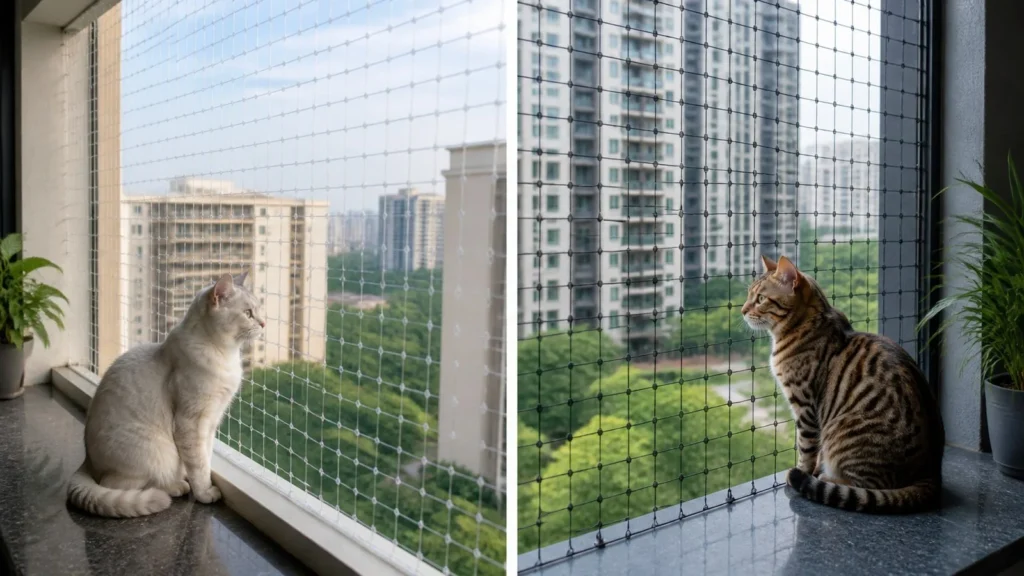
A transparent nylon cat protection net is usually selected when the customer wants the barrier to remain as unobtrusive as possible.
It is a sensible option when:
- The cat has no history of chewing cords, screens or mesh.
- The installation is for a window or a standard apartment balcony.
- Preserving the view is a high priority.
- The customer wants a lightweight DIY kit.
- The product is being positioned at an accessible retail price.
- The owner is willing to inspect the net routinely and replace it if damage appears.
MaxCatNet’s listed transparent configuration uses UV-stabilized virgin nylon monofilament, a 0.40 mm strand and a 30 × 30 mm mesh. These specifications provide a useful starting point, but buyers should still evaluate the actual cat and installation instead of assuming that one mesh size is suitable for every pet.
Transparent nylon is not a poor product simply because a reinforced alternative exists. It solves a different buying problem: creating a visible barrier that has minimal effect on the appearance of a balcony or window.
When Is a Wire-Reinforced Cat Net Worth the Extra Cost?
A stainless steel wire-reinforced cat net is the more appropriate choice when bite and scratch resistance take priority over near-invisibility.
Consider the reinforced construction for:
- A cat that already bites plastic mesh, cables or similar materials.
- Large, strong or highly active cats.
- Cats that regularly climb the net.
- Kittens whose future behaviour is not yet predictable.
- Multi-cat households where chasing and play may load the barrier suddenly.
- Large balcony or terrace installations.
- Long-term outdoor projects.
- Professional installation companies that want a higher-strength product tier.
MaxCatNet’s listed reinforced construction combines PE/HDPE with stainless steel wire and specifies a 1.0 mm wire diameter with a 30 × 30 mm mesh. The internal reinforcement makes the strand more difficult to sever through ordinary chewing, while the polymer exterior keeps the mesh flexible.
The correct sales term is bite-resistant. “Bite-proof,” “unbreakable” and “escape-proof” are absolute claims that no responsible supplier or installer should make without a defined test method and supporting evidence. A reinforced net can still be compromised by incorrect installation, damaged edges, unsuitable anchors or neglected wear.
Which Net Should You Choose for Different Cats?
Calm Adult Cat
For a calm adult cat with no chewing history, transparent nylon is often sufficient when it is correctly installed and regularly checked. It provides good visibility and is easier to package as a consumer DIY kit.
Kitten or Small Cat
Do not choose only by age or body weight. Check the actual mesh opening, every perimeter gap and the kitten’s ability to push its head or paws through. A commonly used 30 mm mesh may suit many installations, but it should not be presented as universally suitable for every kitten.
Persistent Chewer
Choose wire reinforcement. Also remove or secure loose ends that attract attention, provide suitable enrichment, supervise initial balcony access and inspect the cat’s usual chewing area frequently.
Large or Highly Active Cat
A reinforced net and a stronger fixing system are generally the safer specification. Pay particular attention to anchor spacing, corners and the connection between the net and perimeter support rope.
Multi-Cat Household
Use the behaviour of the most active cat as the selection standard. One calm cat does not reduce the load created when another cat climbs, chases or repeatedly bites the barrier.
Installation Matters as Much as Bite Resistance
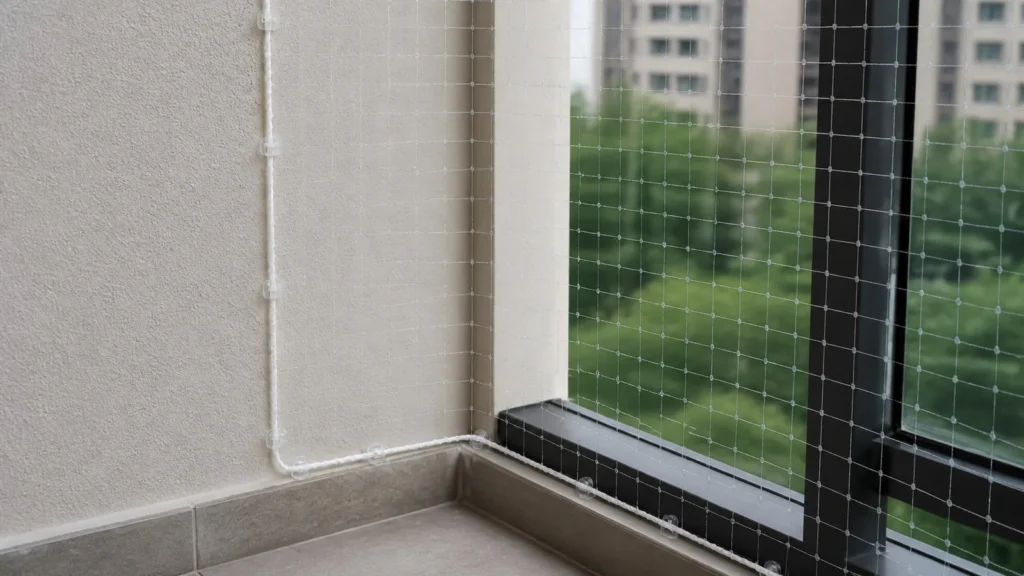
A premium net cannot compensate for an open edge. Before allowing a cat onto a protected balcony, check the complete perimeter from floor to ceiling.
Look for:
- Gaps beside walls, railings, drains, pipes and air-conditioning equipment.
- Loose or widely spaced hooks.
- Adhesive applied to dusty, weak, damp or unsuitable surfaces.
- Unfinished cut edges.
- Areas where the cat can reach an unsafe ledge outside the barrier.
- Excessive sagging or excessive tension.
- Furniture that creates a launch point over or around the net.
No-drill systems can be useful for rental properties, but their suitability depends on the surface, adhesive, curing time, weather exposure and required tension. Large or wind-exposed openings may need drilled anchors, poles, clamps or a professionally designed frame.
Cats Protection’s balcony guidance recommends covering the opening from ceiling to floor, warns that unsecured gaps can allow escape or entanglement, and advises supervising cats while they use a balcony.
If the opening has not yet been measured, use our balcony and window cat-net guide to record the full protected area and identify corners, pipes, railings and other details before cutting the net.
How Often Should a Cat Net Be Inspected?
There is no universal inspection interval for every product and environment. A practical approach is to check the barrier before first use, routinely during use and immediately after anything that may have affected it.
Inspect again after:
- Strong wind, storms or extreme temperatures.
- Building maintenance or movement of balcony furniture.
- A cat has climbed, bitten or become caught in the mesh.
- Hooks or perimeter ropes have been adjusted.
- Long periods when the balcony has not been used.
Replace or repair the system before further access if you find cut or flattened strands, brittleness, unusual discoloration, exposed or corroded wire, pulled intersections, loose anchors, failed adhesive or new perimeter gaps.
What B2B Buyers Should Verify Before Ordering
Retailers, private-label brands, distributors and installation companies should not purchase on colour and price alone. Ask the supplier for information that can be verified and communicated accurately to the final customer.
Product Construction
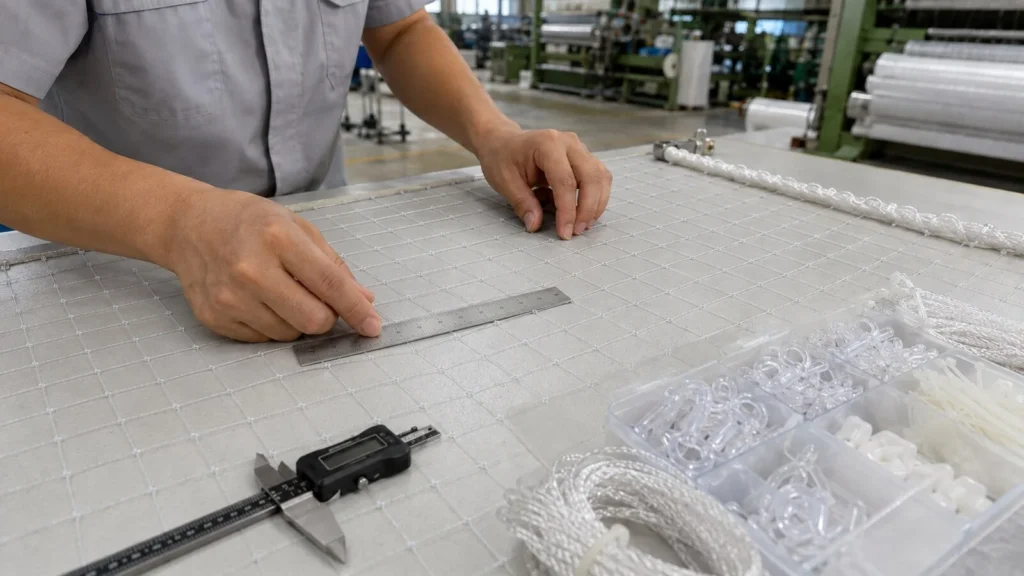
Confirm the outer material, whether the raw material is virgin or recycled, the finished strand diameter, mesh size, reinforcement material and how the wire is incorporated into the strand.
Intended Use
Clarify whether the product is designed for transparent residential kits, habitual chewers, large outdoor installations or professional fitting. One construction should not be marketed as the ideal answer to every scenario.
UV and Weather Performance
Ask what UV stabilization is used and what evidence supports weather-resistance claims. Avoid copying a service-life figure into retail packaging unless the conditions and basis of that figure are clear.
Mesh and Edge Consistency
Check production samples for irregular openings, loose joints, damaged strands and unfinished edges. The quality of a net must remain consistent across the entire panel, not only in the small sample shown in photographs.
Compatible Accessories
Hooks, plugs, ropes, cable ties, adhesive and instructions should match the intended surface and installation method. Selling a strong reinforced net with unsuitable accessories creates a weak system and avoidable complaints.
Responsible Product Claims
Use “bite-resistant” where appropriate and explain that installation, supervision and inspection are still required. Never market a pet net as a child fall-protection product.
Trial Evaluation
Before placing a volume order, obtain samples in the exact construction proposed for production. Compare transparency, strand consistency, mesh dimensions, edge finish, accessory quality and packaging instructions. Do not use a live cat as a destructive test.
The Bottom Line
Can cats bite through a safety net? They can damage some nets, particularly when chewing is persistent or the material has aged. Good-quality transparent nylon remains a practical choice for many ordinary household installations, while stainless steel wire reinforcement offers greater resistance for cats that chew, scratch or climb.
The best product is not simply the strongest or the cheapest. It is the net construction that matches the cat’s behaviour, installation environment and customer expectations—and is then fitted and maintained correctly.
For standard balconies and customers who value a clear view, explore our transparent nylon cat protection net. For active cats, professional projects and buyers prioritising bite resistance, compare our stainless steel wire-reinforced cat net.
If you need custom sizes, roll dimensions, installation accessories or private-label packaging, contact MaxCatNet with your target market, application and expected order quantity.
Frequently Asked Questions
Can a Cat Bite Through a Nylon Cat Net?
Yes. A determined cat can eventually damage a nylon strand, especially through repeated chewing, outdoor ageing or an existing nick. UV-stabilized virgin nylon is appropriate for many standard applications, but habitual chewers should use a wire-reinforced option.
Is a Wire-Reinforced Cat Net Completely Bite-Proof?
No flexible net should be described as completely bite-proof or indestructible. Stainless steel reinforcement improves resistance, but the entire system still depends on intact mesh, secure edges, compatible fixings and regular inspection.
Is Nylon or Wire-Reinforced Netting Better for a Balcony?
Choose nylon when transparency, light weight and value are the main priorities and the cat is not a persistent chewer. Choose wire-reinforced netting for active cats, large cats, climbers, multi-cat homes or customers prioritising strength.
What Mesh Size Is Best for a Cat Net?
A 30 × 30 mm mesh is commonly used, but no single size is suitable for every cat. Consider the animal’s head and body size, age, behaviour and the finished gaps around the complete installation.
Can I Use Adhesive Hooks for a Bite-Resistant Cat Net?
Possibly, but the decision depends on the surface, adhesive system, curing conditions, opening size, weather and net tension. Rough, dusty, weakly painted or wind-exposed surfaces may require another fixing method.
When Should a Cat Net Be Replaced?
Replace it when strands are cut, abraded, brittle or badly discoloured; when reinforcement is exposed or corroded; when mesh intersections deform; or when hooks, anchors or adhesive no longer remain secure.
Can a Cat Safety Net Be Used for Child Protection?
No. Cat netting is a pet-containment product and should never be sold or installed as a child fall-protection system.