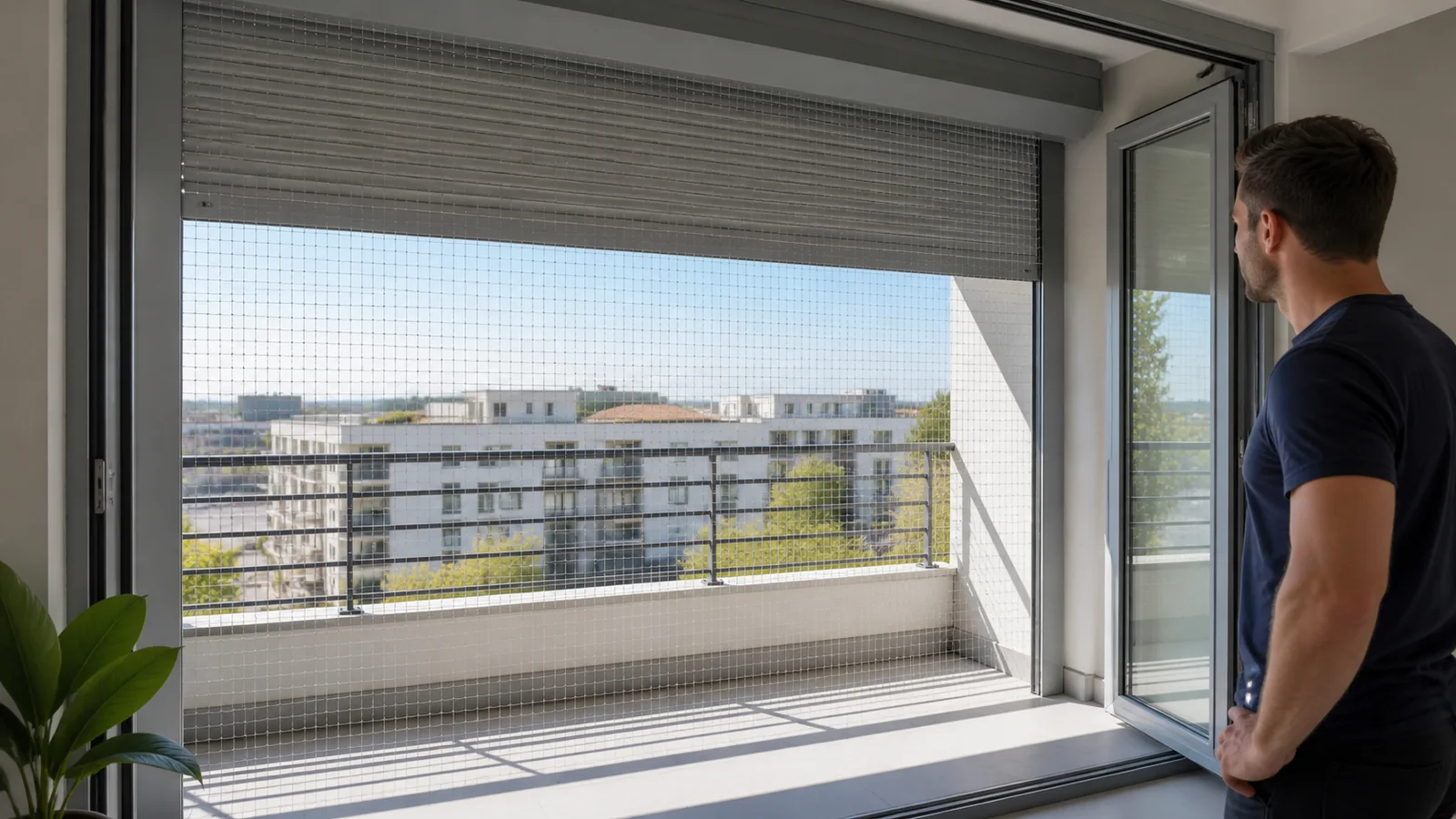
A balcony or window can look straightforward until an exterior blind or roller shutter moves. The curtain may travel inside side guides, collect in a top housing, project outward, or require access for cleaning and service. A cat net planned from a single open-position photograph can cross that path or hide a serviceable component. The survey therefore needs full movement evidence, separate net and equipment planes, verified fixing zones, permission review, and a final cycle check. This planning reduces foreseeable conflicts; it does not create an absolute safety guarantee.
Identify the Exact Moving System
the survey distinguishes a roller shutter, exterior venetian blind, fabric screen, security shutter, or another moving facade component. For this cat net roller shutter exterior blind clearance task, the responsible team should record the product type, housing, side guides, bottom bar, controls, operating direction, and who maintains it. The check belongs at the point where the physical condition and its identity can still be verified together.
At the identify the exact moving system stage, retain wide exterior and interior views, component close-ups, opening ID, floor and unit, and available equipment documents. Link each photograph, count, mark, drawing, or note to the cat net roller shutter exterior blind clearance item it describes, including the current location and responsible role where those facts matter.
Similar-looking blind systems can have different travel and service needs. That boundary governs cat net roller shutter exterior blind clearance, not a different product or site. When evidence supports more than one interpretation, record the uncertainty and route it to the qualified decision owner.
Close identify the exact moving system only when the installer and building contact agree which system occupies the opening. If open, preserve the cat net roller shutter exterior blind clearance state and name the unresolved point, owner, next evidence, and hold or follow-up action before physical custody or project work changes.
Before moving on, compare wide exterior and interior views, component close-ups, opening ID, floor and unit, and available equipment documents with the release condition: the installer and building contact agree which system occupies the opening. This final comparison gives the cat net roller shutter exterior blind clearance handoff enough context for the next buyer, supplier, warehouse, installer, operator, or project reviewer to act without rebuilding the chronology.
Observe the Full Operating Envelope
the lowest, highest, intermediate, tilted, projected, and maintenance positions relevant to the real system are understood. For this cat net roller shutter exterior blind clearance task, the responsible team should operate the equipment only under authorized site procedures and mark the swept volume without placing hands or tools in moving parts. The check belongs at the point where the physical condition and its identity can still be verified together.
At the observe the full operating envelope stage, retain photos or video at key positions, guide clearances, bottom-bar path, protrusions, control location, and any abnormal movement. Link each photograph, count, mark, drawing, or note to the cat net roller shutter exterior blind clearance item it describes, including the current location and responsible role where those facts matter.
One static position cannot define a moving envelope. That boundary governs cat net roller shutter exterior blind clearance, not a different product or site. When evidence supports more than one interpretation, record the uncertainty and route it to the qualified decision owner.
Close observe the full operating envelope only when the project drawing shows the complete no-conflict zone. If open, preserve the cat net roller shutter exterior blind clearance state and name the unresolved point, owner, next evidence, and hold or follow-up action before physical custody or project work changes.
Before moving on, compare photos or video at key positions, guide clearances, bottom-bar path, protrusions, control location, and any abnormal movement with the release condition: the project drawing shows the complete no-conflict zone. This final comparison gives the cat net roller shutter exterior blind clearance handoff enough context for the next buyer, supplier, warehouse, installer, operator, or project reviewer to act without rebuilding the chronology.
Choose a Separate Net Plane
the proposed mesh, perimeter cable, frame, or fixing line stays outside the blind path and preserves door or window use. For this cat net roller shutter exterior blind clearance task, the responsible team should draw section views through the housing, guides, sill, rail, ceiling, and side returns, then compare fixing options with the exact facade materials. The check belongs at the point where the physical condition and its identity can still be verified together.
At the choose a separate net plane stage, retain dimensioned opening elevation, section sketches, proposed plane, junction details, and access notes. Link each photograph, count, mark, drawing, or note to the cat net roller shutter exterior blind clearance item it describes, including the current location and responsible role where those facts matter.
Mesh must not use the moving blind or shutter as its structural support. That boundary governs cat net roller shutter exterior blind clearance, not a different product or site. When evidence supports more than one interpretation, record the uncertainty and route it to the qualified decision owner.
Close choose a separate net plane only when a qualified installer accepts a continuous boundary that does not enter the operating envelope. If open, preserve the cat net roller shutter exterior blind clearance state and name the unresolved point, owner, next evidence, and hold or follow-up action before physical custody or project work changes.
Before moving on, compare dimensioned opening elevation, section sketches, proposed plane, junction details, and access notes with the release condition: a qualified installer accepts a continuous boundary that does not enter the operating envelope. This final comparison gives the cat net roller shutter exterior blind clearance handoff enough context for the next buyer, supplier, warehouse, installer, operator, or project reviewer to act without rebuilding the chronology.
Moving-Boundary Survey Matrix
The matrix keeps the net system and blind system separate while showing where their paths and responsibilities meet.
| Review Point | Evidence | Hold or Release Question |
|---|---|---|
| Blind or shutter | Housing, guides, bottom bar and full travel | Is the operating envelope visible? |
| Net plane | Section, perimeter, fixings and side returns | Is it structurally independent? |
| Service | Access covers, cleaning and responsible trade | Can required work continue? |
| Handover | Cycle check, edge inspection and occupant record | Were conflicts closed before release? |
Preserve Service and Cleaning Access
the housing, guides, control components, glazing, drainage, and facade surfaces remain accessible as required by responsible trades. For this cat net roller shutter exterior blind clearance task, the responsible team should ask the blind contractor or building manager what covers, fasteners, panels, or routes need future access and show them on the net plan. The check belongs at the point where the physical condition and its identity can still be verified together.
At the preserve service and cleaning access stage, retain service zones, removable net sections if approved, responsible trade, access method, and reinstatement owner. Link each photograph, count, mark, drawing, or note to the cat net roller shutter exterior blind clearance item it describes, including the current location and responsible role where those facts matter.
A convenient permanent net detail cannot override building or equipment maintenance needs. That boundary governs cat net roller shutter exterior blind clearance, not a different product or site. When evidence supports more than one interpretation, record the uncertainty and route it to the qualified decision owner.
Close preserve service and cleaning access only when all service interfaces have an agreed access and reinspection route. If open, preserve the cat net roller shutter exterior blind clearance state and name the unresolved point, owner, next evidence, and hold or follow-up action before physical custody or project work changes.
Before moving on, compare service zones, removable net sections if approved, responsible trade, access method, and reinstatement owner with the release condition: all service interfaces have an agreed access and reinspection route. This final comparison gives the cat net roller shutter exterior blind clearance handoff enough context for the next buyer, supplier, warehouse, installer, operator, or project reviewer to act without rebuilding the chronology.
Resolve Permissions and Responsibility
the project identifies who can approve facade fixings, no-drill frames, equipment proximity, access work, and future modifications. For this cat net roller shutter exterior blind clearance task, the responsible team should route drawings to the property owner, building manager, blind contractor, installer, and resident according to the project. The check belongs at the point where the physical condition and its identity can still be verified together.
At the resolve permissions and responsibility stage, retain approval status, comments, revised detail, rejected option, responsible person, and expiry or condition where applicable. Link each photograph, count, mark, drawing, or note to the cat net roller shutter exterior blind clearance item it describes, including the current location and responsible role where those facts matter.
Product supply alone does not approve drilling or attachment to a building system. That boundary governs cat net roller shutter exterior blind clearance, not a different product or site. When evidence supports more than one interpretation, record the uncertainty and route it to the qualified decision owner.
Close resolve permissions and responsibility only when the selected method has documented technical and property approval. If open, preserve the cat net roller shutter exterior blind clearance state and name the unresolved point, owner, next evidence, and hold or follow-up action before physical custody or project work changes.
Before moving on, compare approval status, comments, revised detail, rejected option, responsible person, and expiry or condition where applicable with the release condition: the selected method has documented technical and property approval. This final comparison gives the cat net roller shutter exterior blind clearance handoff enough context for the next buyer, supplier, warehouse, installer, operator, or project reviewer to act without rebuilding the chronology.
Cycle and Handover the Finished Interface
the blind, shutter, window, door, and net boundary can be observed together after installation without contact, snagging, or hidden access conflict. For this cat net roller shutter exterior blind clearance task, the responsible team should perform authorized operating checks, inspect perimeter continuity, record abnormal contact, and explain future service coordination to the occupant. The check belongs at the point where the physical condition and its identity can still be verified together.
At the cycle and handover the finished interface stage, retain final wide views, key moving positions, fixing and edge details, handover date, open exception, and reinspection trigger. Link each photograph, count, mark, drawing, or note to the cat net roller shutter exterior blind clearance item it describes, including the current location and responsible role where those facts matter.
A completion photo cannot promise that later building work or misuse will leave the system unchanged. That boundary governs cat net roller shutter exterior blind clearance, not a different product or site. When evidence supports more than one interpretation, record the uncertainty and route it to the qualified decision owner.
Close cycle and handover the finished interface only when the installer releases the work and the occupant understands the interface limits. If open, preserve the cat net roller shutter exterior blind clearance state and name the unresolved point, owner, next evidence, and hold or follow-up action before physical custody or project work changes.
Before moving on, compare final wide views, key moving positions, fixing and edge details, handover date, open exception, and reinspection trigger with the release condition: the installer releases the work and the occupant understands the interface limits. This final comparison gives the cat net roller shutter exterior blind clearance handoff enough context for the next buyer, supplier, warehouse, installer, operator, or project reviewer to act without rebuilding the chronology.
Buyer Checklist
- Name the exact blind or shutter system.
- Observe every authorized operating position.
- Draw the equipment envelope and net plane in section.
- Keep mesh and fixings independent of moving parts.
- Preserve service, cleaning, and glazing access.
- Obtain building and technical approvals.
- Cycle the interface and document the handover.
Frequently Asked Questions
Can the cat net attach to a shutter guide?
Only a qualified installer and the responsible equipment or building authority can approve an exact interface. A guide is part of a moving system and should never be assumed to be a fixing substrate.
Is one photo with the shutter open enough?
No. The survey needs relevant open, closed, intermediate, and service positions so the full equipment envelope is understood.
Can a removable panel solve every service conflict?
A removable detail still needs structural approval, reliable reinstatement, edge control, access ownership, and post-service inspection.
Related Product or Reading
Use the balcony and window measurement guide to build the base opening record before adding the moving-equipment overlay.
Discuss the Exact Project
Send MaxCatNet opening photos, shutter or blind type, full movement views, building materials, proposed net plane, fixing restrictions, service zones, dimensions, and approval status.