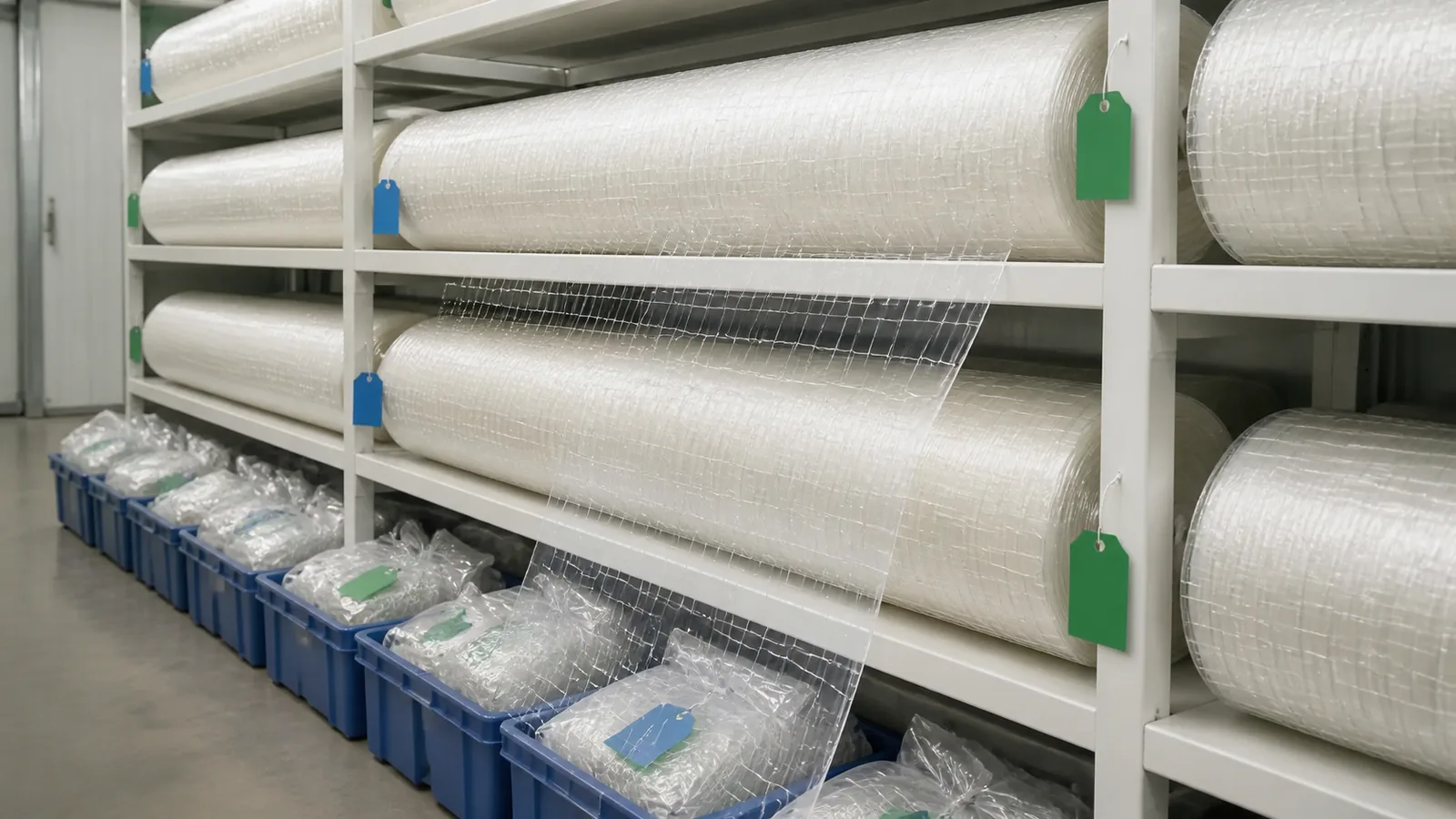
Transparent cat net material can be difficult to identify once labels separate from a roll. It can also pick up dust, oils, sharp-object damage, crushing, or tangles before installation if it is placed with general tools and construction materials. These conditions may not be obvious until a large panel is unfolded at the site.
Storage control is therefore less about choosing a universal number and more about preserving identity, cleanliness, shape, and traceability. Receiving staff record the roll and packaging condition, place it in a clean protected area, prevent sharp or contaminating contact, and release only the material tied to an approved cutting plan. Remaining pieces return to stock with dimensions and identity intact.
Receive Rolls by Identity and Condition
Check packaging and product references before material enters general storage. The working record for this stage covers purchase order, product and color, roll identifier, quantity or dimensions as supplied, packaging condition, visible damage, and receiving photographs.
Records for this stage
- purchase order: source, location, owner, status, and date.
- product and color: source, location, owner, status, and date.
- roll identifier: source, location, owner, status, and date.
- quantity or dimensions as supplied: source, location, owner, status, and date.
- packaging condition: source, location, owner, status, and date.
- visible damage: source, location, owner, status, and date.
Why this stage can fail: Discarding outer labels before the material receives an internal stock identity. Use purchase order, product and color, and roll identifier to document the exception, and keep quantity or dimensions as supplied with the reviewer's decision.
Release condition: Every accepted roll has a traceable code and exceptions remain isolated for review. Record any exception against visible damage, name its owner and next action, and keep receiving photographs open until resolved.
Choose a Clean Protected Storage Zone
Separate rolls from moisture sources, dirt, traffic, sharp hardware, and contaminating materials. The working record for this stage covers rack location, floor clearance, cover condition, nearby chemicals, sharp-object control, traffic route, and access owner.
Records for this stage
- rack location: source, location, owner, status, and date.
- floor clearance: source, location, owner, status, and date.
- cover condition: source, location, owner, status, and date.
- nearby chemicals: source, location, owner, status, and date.
- sharp-object control: source, location, owner, status, and date.
- traffic route: source, location, owner, status, and date.
Why this stage can fail: Placing light net rolls under heavy stock or beside sealants, oils, grinding work, and loose fasteners. Use rack location, floor clearance, and cover condition to document the exception, and keep nearby chemicals with the reviewer's decision.
Release condition: The storage location keeps the rolls supported, clean, dry, and accessible without uncontrolled stacking. Record any exception against traffic route, name its owner and next action, and keep access owner open until resolved.
Support Rolls Without Crushing or Tangling
Handle packaged rolls and loose material in a way that preserves their form and edges. The working record for this stage covers support points, stacking rule, package orientation, lifting method, loose-end restraint, edge protection, and handling equipment.
Records for this stage
- support points: source, location, owner, status, and date.
- stacking rule: source, location, owner, status, and date.
- package orientation: source, location, owner, status, and date.
- lifting method: source, location, owner, status, and date.
- loose-end restraint: source, location, owner, status, and date.
- edge protection: source, location, owner, status, and date.
Why this stage can fail: Dragging a roll across rough floors or pulling one loose layer from a compressed stack. Use support points, stacking rule, and package orientation to document the exception, and keep lifting method with the reviewer's decision.
Release condition: The roll remains stable, edges are not snagged, and handling follows the supplier packaging form. Record any exception against edge protection, name its owner and next action, and keep handling equipment open until resolved.
Release Material Against a Cutting Plan
Match the selected roll to the approved panel list before opening or cutting it. The working record for this stage covers job code, roll code, material specification, cutting schedule, panel count, cutting area, and responsible cutter.
Records for this stage
- job code: source, location, owner, status, and date.
- roll code: source, location, owner, status, and date.
- material specification: source, location, owner, status, and date.
- cutting schedule: source, location, owner, status, and date.
- panel count: source, location, owner, status, and date.
- cutting area: source, location, owner, status, and date.
Why this stage can fail: Opening several similar rolls at once and losing which material supplied each panel. Use job code, roll code, and material specification to document the exception, and keep cutting schedule with the reviewer's decision.
Release condition: One source roll and its intended panels remain identifiable throughout the cutting sequence. Record any exception against cutting area, name its owner and next action, and keep responsible cutter open until resolved.
Return Remaining Material as Controlled Stock
Measure, protect, and relabel useful residual material after cutting. The working record for this stage covers remaining roll length, offcut dimensions, edge condition, contamination check, source roll, reserved job, and return date.
Records for this stage
- remaining roll length: source, location, owner, status, and date.
- offcut dimensions: source, location, owner, status, and date.
- edge condition: source, location, owner, status, and date.
- contamination check: source, location, owner, status, and date.
- source roll: source, location, owner, status, and date.
- reserved job: source, location, owner, status, and date.
Why this stage can fail: Rolling scraps together without dimensions or product identity and later treating them as approved full stock. Use remaining roll length, offcut dimensions, and edge condition to document the exception, and keep contamination check with the reviewer's decision.
Release condition: Each retained piece has a usable-size record and unsuitable material is clearly segregated. Record any exception against reserved job, name its owner and next action, and keep return date open until resolved.
Pre-Installation Storage Register
The register follows material from receipt to rack, cutting table, project release, and controlled return.
| Review Point | Evidence to Keep | Release Question |
|---|---|---|
| Receive Rolls by Identity and Condition | purchase order, product and color, roll identifier, and quantity or dimensions as supplied | every accepted roll has a traceable code and exceptions remain isolated for review. |
| Choose a Clean Protected Storage Zone | rack location, floor clearance, cover condition, and nearby chemicals | the storage location keeps the rolls supported, clean, dry, and accessible without uncontrolled stacking. |
| Support Rolls Without Crushing or Tangling | support points, stacking rule, package orientation, and lifting method | the roll remains stable, edges are not snagged, and handling follows the supplier packaging form. |
| Release Material Against a Cutting Plan | job code, roll code, material specification, and cutting schedule | one source roll and its intended panels remain identifiable throughout the cutting sequence. |
| Return Remaining Material as Controlled Stock | remaining roll length, offcut dimensions, edge condition, and contamination check | each retained piece has a usable-size record and unsuitable material is clearly segregated. |
Roll Storage Checklist
- Assign an internal identity before outer shipping labels can be lost or discarded.
- Keep rolls away from wet areas, dust-producing work, chemicals, sharp hardware, and vehicle routes.
- Support the packaged form and restrain loose ends without crushing or dragging the mesh.
- Open only the roll linked to the current approved cutting schedule.
- Measure and relabel useful remaining material before it returns to the rack.
Cat Net Roll Storage Questions
Can rolls be stored outside under a cover?
A cover alone may not control moisture, dirt, wind movement, sharp contact, or identity loss. Use the supplier's storage guidance and a protected location appropriate to the material and packaging.
What if the outer packaging arrives torn?
Photograph it, preserve the labels, isolate the roll, and inspect accessible material for contamination, snagging, deformation, or missing identity before acceptance.
How should a partly used roll be recorded?
Keep its original product and roll identity, measure the usable remainder, protect the exposed edge, and record any reserved project or restriction.
Related Product or Reading
- Transparent nylon cat net range: anchors storage records to the selected product
- Cat net roll cutting plan: continues the controlled handoff from storage to panel production
Define the Storage and Release Handoff
Share the material identity, supplied roll form, packaging condition, storage location, handling limits, cutting schedule, panel labels, and remaining-stock rules with MaxCatNet. That project evidence lets MaxCatNet review the selected transparent nylon cat net roll for this buyer task: Protect the identity and visible condition of cat net rolls before they are measured, cut, labeled, and released to installation.