
If watering plants, operating a handle or cleaning a window seems to require opening a cat-net boundary, describe that access need before ordering. A zipper or snap closure needs its own product and installation proposal; specifying nylon or wire-reinforced mesh does not establish that either closure is available or compatible.
Start with the task and the opening layout, then ask the supplier whether it can offer an appropriate solution. Do not cut an installed panel or add a generic fastener based on this guide. The useful result is a written access brief, a proposed detail and a clear routine for keeping cats away while the boundary is open.
Describe the access task before choosing a closure
Record what the person needs to do, from which side, and what must pass through. A watering-can spout, a cleaning tool and a hand operating a window handle create different requirements. Add how often access is needed and whether another arrangement could perform the task without opening the net.
Check the task from a secure indoor position. Do not lean outside a balcony, climb onto its railing or move the net to obtain a measurement or photograph. Where safe access is not possible, leave that part of the record for the installer to assess.
| Access-brief field | What to record |
|---|---|
| Task and frequency | For example, operating a handle or reaching a planter; describe the actual routine. |
| Object and reach | What must pass through, where the person stands and which movement is needed. |
| Opening layout | Panel outline, surrounding edges, supports, window or door movement and obstacles. |
| Requested zone | Mark the area being considered on a photograph or sketch, without treating it as an approved cut-out. |
| Closure proposal | Supplier to confirm availability, attachment detail, how the ends close and the proposed instructions. |
| Control during use | How cats will be kept inside, who opens and closes the boundary and how it will be checked afterwards. |
Mark the whole panel, including moving parts
Show the complete protected opening rather than only the requested access point. Mark the upper, side and lower boundaries, corners, edge finish and existing attachments. Add the window sash, door or blind in the positions that the user intends to operate.
Ask the supplier or installer to assess the requested location together with those details. There is no generic setback or mid-panel position established here that makes an opening suitable. The proposed detail must explain what happens to the surrounding mesh, edge connection and boundary when it is opened and closed.
For a doorway, first check whether the task is actually a door-clearance problem. The sliding balcony door planning guide covers the door’s movement relative to the net. Adding a closure to the mesh should not be assumed to solve a conflicting door path.
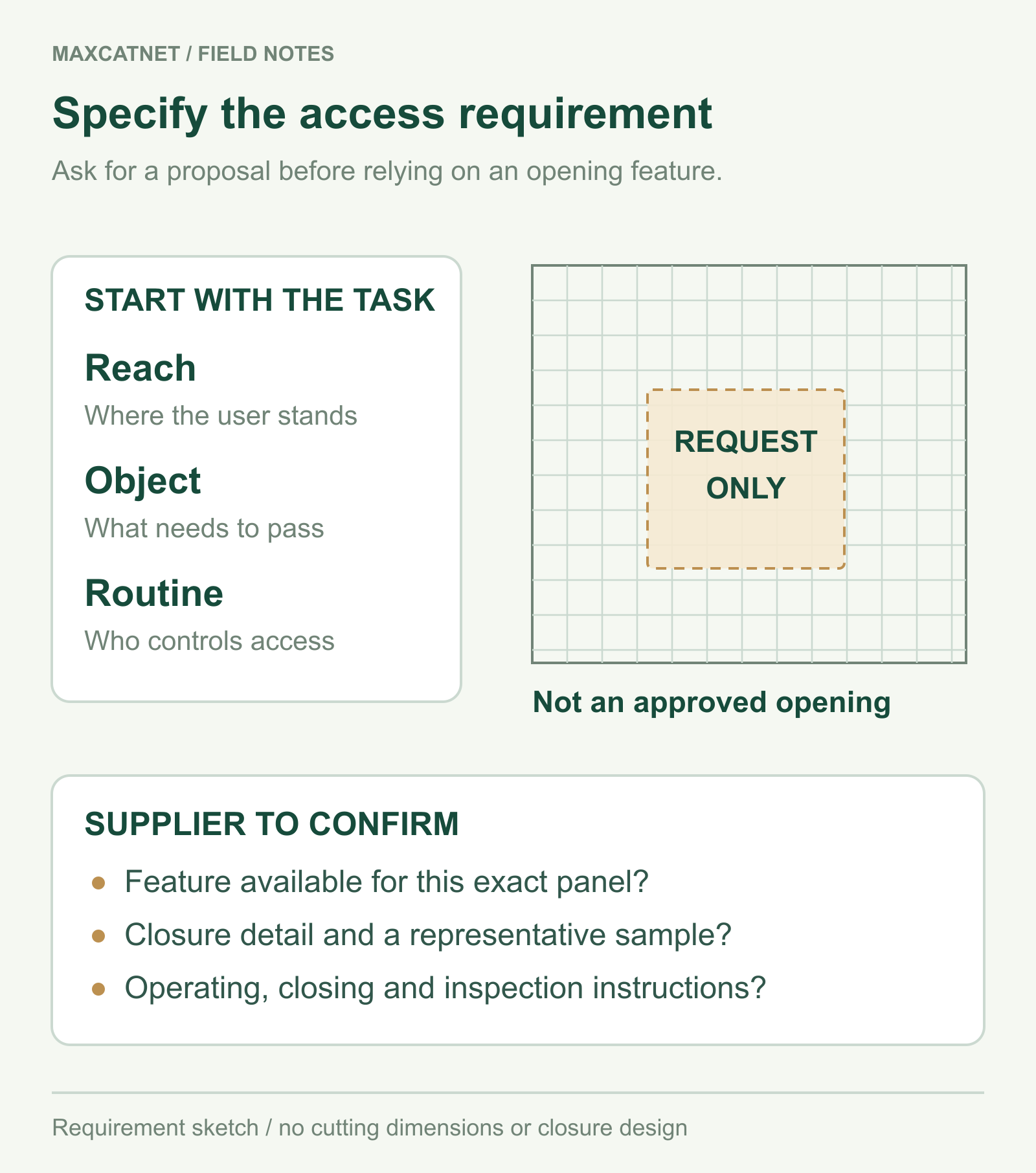
Ask what a zipper or snap proposal actually includes
If a supplier proposes a zipper, ask how it joins the specified net and how the ends and corners close. Identify the proposed slider, stops, edge reinforcement and replacement arrangements in the drawing or sample record. Do not choose it simply because an opening is long or vertical.
If a proposal uses snaps or other separate fasteners, ask how the spaces between fastening points are controlled and how the user confirms that all points are closed. Record the whole closure detail rather than counting visible fasteners alone. No standard quantity or spacing is implied.
For either proposal, request confirmation for the exact nylon monofilament net or HDPE mesh with wire reinforcement being quoted. Neither the material name nor a generic photograph proves that the panel can accept a sewn closure. Ask whether a suitable feature can be supplied before relying on it in the order.
Plan who controls the opening during use
Opening the boundary creates an access route. Keep cats inside and away from that route before operating it. Identify who controls access, completes the task and closes the proposed system; do not leave it open for later or rely on a cat choosing not to approach.
After closing, check the closure ends, surrounding mesh and adjacent edge connections using the supplied instructions. If the closure will not fully engage, a new gap appears or an attachment has moved, keep access restricted while the issue is assessed. Do not treat a sticking slider or separating closure as harmless wear.
Supervision remains part of balcony use: Cats Protection advises supervising cats on balconies. A closure inspection does not establish that a balcony can be left accessible without supervision.
Approve the sample and record the receiving checks
Where an access feature is offered, request a representative sample or assembly that shows its connection to the proposed panel. Agree what the demonstration covers, including operation, closure continuity, interaction with the fixing line and any checks specified by the designer. Observe the sample without using a cat as a test subject.
Link the drawing revision, sample reference and accessory list to the quotation. If the order changes material, dimensions, edge construction or closure, ask what needs fresh review. The accessory reconciliation guide can help keep each opening’s item references and packing allocation together.
On receipt, check identity, quantity, visible condition and the supplied instructions against that agreed record. For an existing installation, keep closure observations with the cat net maintenance record. Product receipt and an installation assessment are different checks.
Common access-opening questions
Can I add a zipper to any cat net?
Do not assume compatibility. Ask for a proposed detail for the exact panel and fixing arrangement before making an alteration. A material name alone does not establish a usable closure design.
Are zipper and snap panels standard MaxCatNet options?
Ask whether the requested feature can be supplied for your specification. Availability, construction, accessories and sample requirements need written confirmation; this guide does not list a standard closure SKU.
Is a small reach-through opening automatically acceptable?
Size alone does not resolve its location, closed gaps, operating routine or interaction with the panel. Submit the task and layout for assessment, including how cats will be excluded during use.
What if the closure no longer shuts completely?
Keep cats away from the affected opening and request assessment using photographs and the product reference. Do not continue access on the assumption that a partially closed feature is sufficient.
Send an access requirement with the net enquiry
Send MaxCatNet your net and access brief: the intended task, complete panel layout, requested area, material preference, dimensions, quantity and destination. Ask the reply to state whether an access feature can be offered and which product, sample and installation details remain to be agreed.